People often call the Mk1 Volkswagen Golf GTI the first hot hatch. That is not quite right. Earlier sporty hatchbacks had already demonstrated that a small family car could be given more power and attitude. The Golf GTI’s achievement was different, and ultimately more important: it made the formula commercially undeniable.
Volkswagen had planned an initial run of roughly 5,000 cars. Instead, approximately 462,000 first-generation Golf GTIs were produced between 1976 and 1983, although Volkswagen publications also give the more precise figure of 461,700. That difference is minor. The historical point is not. A niche idea became a repeatable product strategy, and the ordinary family hatchback became a legitimate performance-car platform.
That is why the Mk1 GTI still matters. Not because it was the fastest small car of its time, and not because it invented every ingredient in the recipe. It mattered because Volkswagen understood how to integrate the ingredients so completely that other manufacturers could no longer treat the performance hatchback as an amusing side project.
An enthusiast project that escaped the enthusiasts
The GTI began in a surprisingly informal way. Volkswagen press officer Anton Konrad and a small group of engineers pursued the faster Golf through after-hours meetings, prototypes, customer research, chassis work and motorsport possibilities. The group’s project was formally approved on May 28, 1975, after it had demonstrated that the new Golf could support a much more ambitious identity than its economical shape suggested.
That origin story matters because the GTI was not simply a marketing department adding stripes to an existing car. The project had to persuade a cautious manufacturer that an enthusiast derivative was worth building. Its public debut came at the Frankfurt motor show in September 1975, followed by the German-market launch in June 1976.
The recipe was straightforward on paper. The launch car used a naturally aspirated 1.6-liter, four-cylinder engine with front-transverse installation and front-wheel drive. Volkswagen rated it at 110 PS. The engine was paired with a manual transmission, while the chassis received firmer, lower suspension, stabilizer bars and wider wheels. None of those decisions was exotic. That was precisely the clever part.
Volkswagen did not need a new sports-car architecture. It needed to take an existing compact platform seriously. The GTI was an exercise in system integration: power appropriate to the car’s size, a chassis developed around that power, low mass, and enough visual identity to make the result feel intentional. The engineering was not impressive because one component was alien or expensive. It was impressive because the components agreed with one another.
That distinction still matters in an era when performance is often presented as a single number. A car is not a horsepower figure with seats attached. Add power without addressing cooling, tires, brakes, suspension and drivetrain capacity, and you have not necessarily created a better performance car. You have created a new problem with a more exciting press release. The Mk1 GTI succeeded by avoiding that trap before the trap had become fashionable.
Small numbers, vivid sensations
The early GTI’s numbers look modest now. The launch car produced 110 PS, and later 1.8-liter versions introduced for 1982 and 1983 were rated at 112 PS. Volkswagen’s historical material gives the launch car a top speed of 182 km/h. Those figures are not the reason the car became important, but they explain why period observers paid attention when placed beside its size and everyday usability.
A March 1977 Motor Sport road test compared the 1.6-liter GTI with larger-engined rivals from Ford, Leyland and Opel. The review found broadly comparable performance despite the Volkswagen’s displacement disadvantage. More revealingly, it emphasized refinement and equipment while still treating the Golf as a hot rod.
That combination was the surprise. The GTI was not merely a crude little car that happened to accelerate harder than expected. It could behave as ordinary transportation and still give its driver something to manage. The performance was available without requiring the owner to accept a stripped interior, an intolerable ride or a cabin that announced its intentions from half a mile away.
A later Auto Motor und Sport test of a historical 1976 1.6-liter, four-speed car recorded 0-100 km/h in 9.9 seconds and a maximum speed of 182 km/h. That particular test car was measured at 850 kg, a tested figure rather than a universal curb or dry weight. The publication described a high-revving engine, front-heavy balance, understeer when pushed and a lively rear when the driver lifted off the throttle.
Those observations belong to that tested configuration and should not be converted into a timeless statement about every Mk1 GTI. They are still useful because they show what made the car engaging. The GTI was not a machine that erased the driver’s decisions. Rev selection, gear choice, throttle application and weight transfer remained part of the experience. The car asked questions. It also gave reasonably clear answers.
That is the difference between speed and involvement. A modern performance car can cover ground more rapidly while insulating its occupants from much of the process. The Mk1 GTI’s appeal was that its modest output became vivid through low mass, direct controls and a compact footprint. It made the act of driving feel like an activity rather than a software notification received by the chassis.
The quietest car in the room
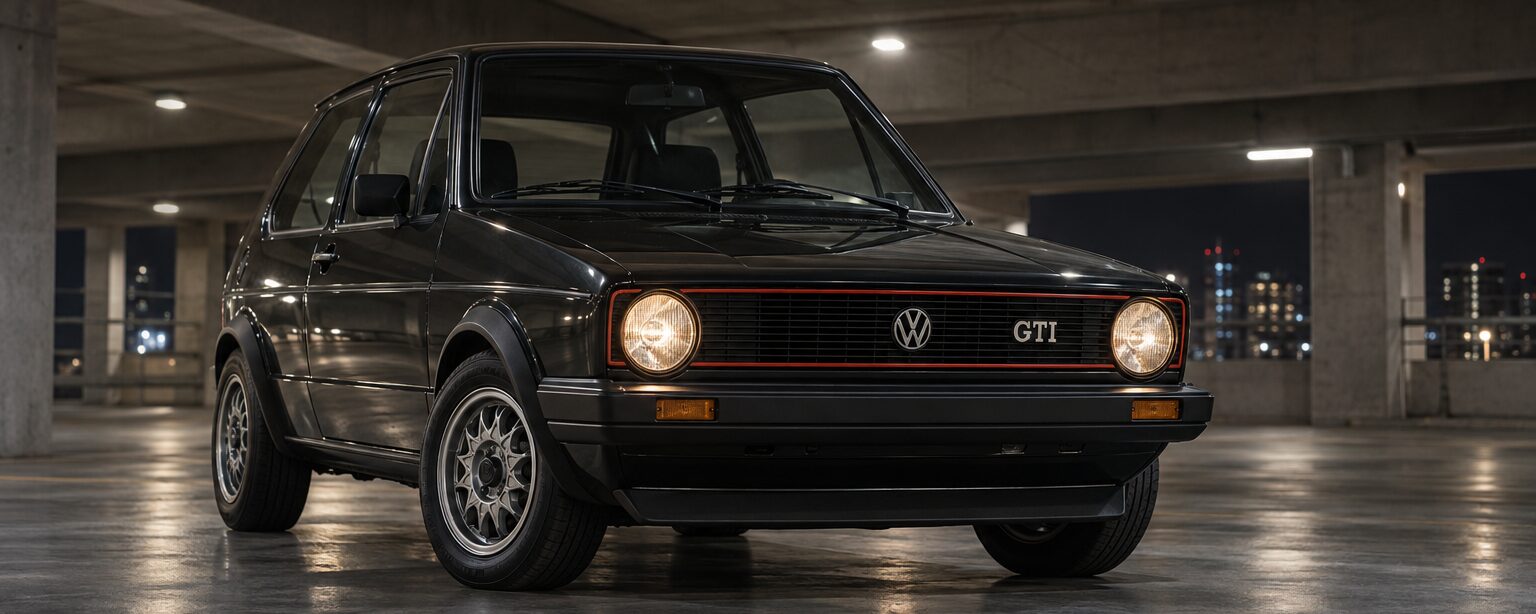
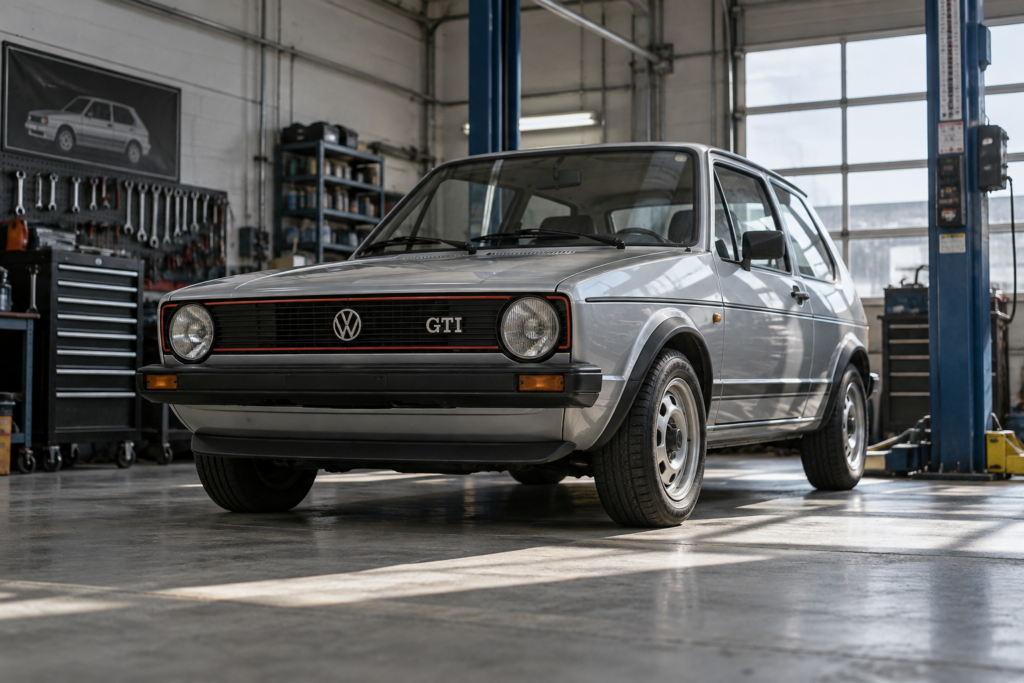
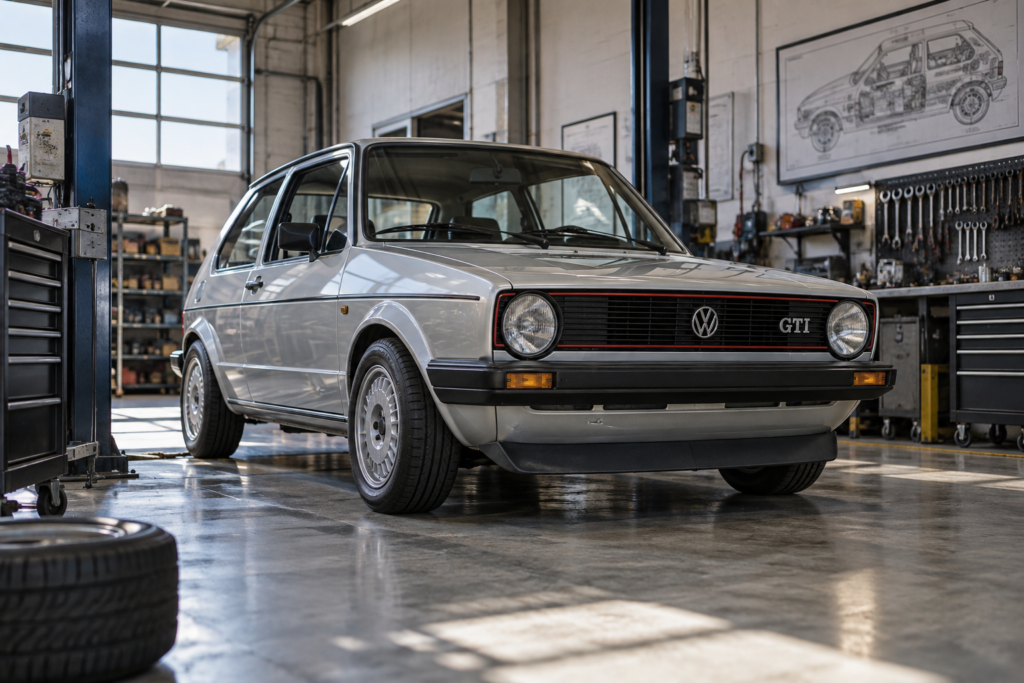
The GTI’s visual identity was unusually disciplined. A red grille surround, black exterior trim and wheel-arch extensions, discreet spoilers, tartan sports seats, a three-spoke steering wheel and a golf-ball gear knob were enough to distinguish it from an ordinary Golf. The basic shape remained intact.
That restraint was not a lack of imagination. It was a design strategy. The GTI did not need an exaggerated body kit to explain itself because the details were memorable and mutually reinforcing. The red stripe became a signal. The tartan became a signature. The golf-ball knob turned a gear change into a small piece of theater.
Volkswagen credits designer Gunhild Liljequist with the tartan upholstery and gear-knob details, and its historical accounts connect the tartan’s cultural charge to contemporary British fashion and punk-era style. That connection should be treated as design context rather than a perfectly documented single-source inspiration chain. Still, the result is obvious in the finished car: a restrained German compact wearing just enough visual rebellion to avoid looking anonymous.
This is where the GTI’s identity became more powerful than its equipment list. It taught performance cars to signal quietly. A red line and a checkered seat could carry more meaning than a body widened into an aerodynamic argument. The car looked close enough to an ordinary Golf to retain a kind of sleeper character, but distinctive enough that enthusiasts could recognize it immediately.
That visual language also helped make the concept repeatable. Manufacturers could understand the business case. Start with a practical family model, give it more convincing mechanical intent, add a handful of durable design cues and let the performance version strengthen the image of the entire range. The GTI did not need to be a separate species. It needed to be the Golf that made the rest of the Golf line more interesting.
From road car to permission slip
Motorsport gave the GTI another form of legitimacy. Volkswagen states that the car received motorsport approval in November 1976 and entered a German one-make cup in 1977. The same basic idea appeared in the United States as the Rabbit Cup. Walter Struckmann won all ten races of the 1978 season, according to Volkswagen’s anniversary publication.
A separate record from the Stiftung Automuseum Volkswagen documents Alfons Stock and Paul Schmuck winning the 1981 German Rally Championship in a Golf GTI. That rally car was heavily modified and should not be confused with a standard road-going GTI. The FIA Historic Database also records the Golf GTI Typ 17 under homologation form 5731, including a 1,588 cc four-cylinder, front-wheel-drive configuration. The FIA database date and Volkswagen’s motorsport-approval date are not the same thing, so they should not be casually merged into one chronology.
The larger significance of the racing program was not simply that the GTI could win. Plenty of cars can be made competitive when enough money and engineering are applied. The one-make cup mattered because it suggested that performance participation could be closer to ordinary ownership. The GTI was not only something to watch from behind a barrier. It was a route into competition culture.
That made the car feel legitimate in two directions at once. It could be a practical road car that embarrassed larger-engined rivals, and it could be a platform for people who wanted to compete. The same compact proportions that made it useful in daily life also made it comprehensible as a racing object. Volkswagen had created a performance car that did not require the owner to abandon ordinary life before the interesting part began.
Four different meanings of “original”
The Mk1 GTI’s success created a problem for its future. Cars that invite modification are rarely preserved untouched. The GTI’s accessible layout encouraged engine swaps, suspension changes, wheel experimentation, aftermarket bodywork and period tuning. Some of those alterations are part of the model’s real enthusiast history. Others simply made individual cars less representative of what they were built to be.
There is no honest reason to treat every modified GTI as ruined. A documented period-tuned car can be historically meaningful. The Oettinger GTI 16S, for example, belongs to the story of how owners and specialists pushed the platform beyond its standard specification. A rally car, a period street build, a carefully restored original and an intelligently updated driver’s car can all deserve attention for different reasons.
But modification and improvement are not synonyms. Lowering a car may change its stance while degrading suspension travel. Larger wheels may sharpen the visual impact while adding weight and reducing compliance. More power may make the engine feel stronger while exposing weaknesses elsewhere. The best modification solves a specific limitation without creating three new ones.
This is why the Mk1 GTI’s historical originality, driving quality and personal meaning should be judged separately. A stock car may be the strongest surviving document of Volkswagen’s original idea. A period modification may preserve the way enthusiasts actually used the car. A restomod may provide the most enjoyable driving experience. None of those claims automatically cancels the others.
The collector world often wants a single ranking: original is good, modified is bad. The GTI resists that simplicity because modification was always part of its cultural ecosystem. Yet the opposite argument is just as lazy. Calling every alteration “period correct” does not make it historically important. The car’s meaning comes from what the changes reveal, not merely from the fact that someone changed something.
When trim became evidence
The shift from accessible used performance car to collector artifact changed how people look at the Mk1. Details that once seemed replaceable now function as evidence. Correct trim, wheel types, upholstery, identity numbers and configuration consistency can tell a story about what a particular car was, how it was used and how much of that identity survived.
Volkswagen Classic Parts provides identification guidance for Mk1 cars. Through 1980, the type plate was located beside the hood lock, the 110-hp engine number was at the front of the block beneath the head joint, and the chassis number was on top of the right strut mount. From 1981, the chassis-number location moved to the rear cross wall of the engine compartment.
Those locations are useful checks, not magical proof. An FIA homologation record authenticates the identity and homologated specification of the Typ 17 competition record; it does not prove that an individual road car retains its original engine, body, transmission, options or competition specification. Appearance cannot do that either. A red stripe can be replaced. Tartan can be recreated. A golf-ball gear knob is not a notarized birth certificate.
The strongest authentication is a hierarchy: identity numbers, documentation, configuration consistency, correct trim and a coherent history that does not require the car to be more special than the evidence allows. That may sound less romantic than trusting a polished restoration, but a surviving GTI is now valuable partly because it preserves information. The car is not just an old fast hatchback. It is a record of how Volkswagen and its customers understood performance at a particular moment.
The category-defining car
The Mk1 Golf GTI did not invent the sporty hatchback. It did something more durable. It turned the concept from an interesting possibility into a product formula that manufacturers could repeat, buyers could understand and enthusiasts could modify.
Its success came from refusing to separate performance from ordinary life. The engine was energetic without being exotic. The chassis was serious without turning the car into a punishment device. The appearance was distinctive without becoming theatrical. Motorsport supplied credibility, while the everyday Golf body kept the whole project connected to reality.
That is why the planned 5,000-car run matters beside the approximately 462,000 first-generation cars that followed. The first number describes a cautious institution testing an idea. The second describes an idea that escaped its original boundaries. Volkswagen did not merely build a fast version of the Golf. It demonstrated that an enthusiast derivative could become central to a model’s identity.
The Mk1 GTI therefore carries several kinds of significance at once. As an original artifact, it preserves a moment when performance design learned the power of restraint. As a driver’s car, it shows how low mass and direct involvement can make modest output feel substantial. As a personal object, it can represent a first mechanical education, a family memory or an entry into a larger enthusiast world.
Those values should not be collapsed into one another. The most original GTI is not automatically the most enjoyable. The fastest modified car is not automatically the most important. The car with the deepest personal meaning may be impossible to price or authenticate through specifications at all.
The enduring achievement of the Mk1 Golf GTI is that it made room for all three. It gave the industry a template, drivers a more vivid kind of ordinary car and enthusiasts a platform that could become something personal. That is more than being first. It is being the car that made everyone else take the idea seriously.