Skip to content
CarBuy

Ferrari 458 Italia

2009–2015Italian supercar

Ferrari 458 Italia

Enthusiasts should care because the 458 Italia combines a naturally aspirated 4.5-liter V8 producing 570 horsepower with a seven-speed dual-clutch gearbox and electronically controlled chassis systems, making its engineering transition especially meaningful.

Feature

Ferrari 458 Italia: The Farewell Disguised as Progress

Ferrari did not unveil the 458 Italia as a farewell. In September 2009, at the Frankfurt Motor Show, it was simply the next mid-engine V8 Ferrari, the successor to the F430 and another step in a lineage that had spent decades making ordinary roads feel like a clerical error. The historical weight came later.

When Ferrari replaced the 458 with the turbocharged 488 GTB in 2015, the Italia became something nobody had quite recognized while it was new: the closing statement of Ferrari’s naturally aspirated mid-engine V8 road-car tradition. That claim needs its boundaries. It does not make the 458 the last naturally aspirated Ferrari of every kind, nor does it turn the base Italia into a limited-production derivative by association. It means something more precise and more interesting. The 458 was the point where an old idea reached extraordinary maturity just before Ferrari changed the subject.

That is why the car still deserves attention. Its importance is not hiding in a production number that cannot be cleanly separated from the 458 Spider, Speciale, Speciale A, Challenge, GT2/GTE, and GT3 derivatives. Nor does it require auction mythology. The 458 matters because it fused a high-revving engine, a dual-clutch gearbox, sophisticated electronic control, and an unusually clear driver interface into one coherent machine. Ferrari made the electronics feel less like supervision and more like fluency.

The last of something, almost by accident

The 458’s retrospective meaning begins with an awkward truth: it was not born nostalgic. Ferrari presented it as progress. The car’s 4.5-liter naturally aspirated V8 used direct injection, dry-sump lubrication, a 90-degree layout, and a 12.5:1 compression ratio. Factory figures gave it 570 horsepower and 540 Nm of torque, with peak torque arriving at 6,000 rpm. Those numbers were serious in 2010, but they do not explain the car by themselves.

The more revealing number is the engine’s 9,000-rpm redline. A turbocharged engine can deliver astonishing force with less need for theatrical escalation. The 458’s V8 asked for patience, then rewarded it. Power built as the revs climbed, turning acceleration into a sequence rather than a single event. The engine did not merely provide speed; it gave speed a plot.

That distinction became clearer after the 488 GTB arrived with turbocharging. The 458 suddenly stood on the far side of a technical boundary. Its naturally aspirated V8 represented a particular relationship between throttle, revs, sound, and anticipation, one that Ferrari’s turbocharged future would necessarily alter. The 458 was still a contemporary supercar, but it became a historical object almost immediately afterward.

Ferrari’s corporate history documents May 2015 as the point when 458 Italia production was discontinued as the 488 GTB took over. The endpoint is clear. The total build count is not. Ferrari’s public shipment categories group parts of the wider V8 sports-car family, and those figures do not provide a dependable Italia-coupe ledger. That may frustrate collectors who want a neat scarcity argument, but it is also a useful lesson. The 458 does not need an invented number to establish its place in history.

When electronics stopped being the villain

For years, the enthusiast argument about electronic assistance was easy to understand. A purist wanted the machine to communicate directly, without software filtering the conversation. Ferrari complicated that argument with the 458.

The Italia’s electronic differential, F1-Trac traction control, stability systems, ABS, brake-control logic, magnetorheological dampers, and dual-clutch gearbox were not isolated gadgets scattered across the car like expensive accessories. They worked through a driver-facing system centered on the steering wheel and its manettino control. Ferrari’s own material emphasized Formula 1 influence, aerodynamic management, and the relationship between cockpit controls and chassis behavior. That account is naturally promotional, but period testing gave the idea independent shape.

Contemporary reviewers repeatedly focused on steering clarity, confidence, braking, and the unusual ease with which a driver could understand what the car was doing. The important word is not easy in the lazy sense. The 458 was not domesticated. A 2010 European-market car tested by Car and Driver recorded 3.3 seconds to 60 mph, an 11.5-second quarter-mile at 125 mph, 161 feet from 70 mph to a stop, and 0.95 g on a 300-foot skidpad. A separate MotorTrend test of a 2010 458 recorded 3.0 seconds to 60 mph and an 11.1-second quarter-mile at 125.2 mph.

Those are individual test events, not universal promises for every 458. Their real value is contextual. The car was very fast, but the contemporary fascination centered on how legible that speed felt. A competent driver did not need to be a professional racer to begin working with the car’s abilities. The systems were not merely preventing mistakes. They were helping turn a very large performance envelope into something a human could read.

That was the 458’s great engineering achievement. Ferrari did not make complexity disappear. It made complexity arrive at the right moment, in the right proportion, through controls that felt like part of the car’s personality. The electronics became part of the emotional experience rather than a layer enthusiasts had to tolerate.

A purist’s Ferrari with no manual gearbox

Here is the contradiction that keeps the 458 interesting: it is often treated as a modern purist’s Ferrari, yet it was the first Ferrari road car offered without a manual-transmission option.

The seven-speed dual-clutch automated transmission was quicker and smoother than Ferrari’s earlier F1 automated manuals. By the standards of the period, the decision was logical. The gearbox could change ratios with remarkable speed, and it allowed the engine and chassis systems to operate with a precision that would have been difficult to match through a conventional manual transmission. Ferrari was not removing involvement so much as redefining it.

But a clutch pedal is not only a mechanism. It is a ritual, a physical interruption in the process of going quickly. Ferrari’s open-gated manuals had made that interruption part of the brand’s mythology. The 458 closed the gate with impressive technical competence, then left enthusiasts to decide whether competence was enough.

That is why the car’s lack of a manual cannot be filed away as either a flaw or a triumph. It was both a technological victory and a cultural rupture. The F430 had represented the coexistence of old and new Ferrari interaction. The 458 chose the new path completely. Its celebrated purity was therefore not mechanical simplicity. It was purity of response, accuracy, and communication, delivered through software and paddles.

Some enthusiasts found that liberating. Others heard the final click of the traditional Ferrari manual and have been complaining about it ever since. Both reactions make sense. The 458 asks whether driver involvement means performing every task yourself or understanding, trusting, and exploiting the tasks the machine performs for you. That was not an abstract question in 2010. It was the future arriving with a very expensive steering wheel.

The engine gives the car its memory

The chassis explains why the 458 could be used so effectively. The engine explains why anyone remembers using it.

Ferrari’s 4.5-liter V8 was naturally aspirated and direct-injected, with a dry-sump system and an appetite for engine speed. The displacement was 4,499 cc, but the important design choice was not simply how much air and fuel the engine could process. It was how Ferrari shaped the delivery. Contemporary technical coverage highlighted friction-reduction measures, high compression, and the engine’s willingness to keep building toward its 9,000-rpm redline.

This is where spec-sheet arguments become inadequate. Two engines can produce similar acceleration and leave entirely different impressions. The 458’s power arrived as a crescendo. The response sharpened as the revs rose, and the driver was encouraged to remain in that upper range rather than surf a broad, low-end torque wave. It made anticipation part of the performance.

There was a certain corporate absurdity in the whole exercise. Ferrari had built an increasingly sophisticated road car, surrounded its driver with electronic assistance, and then installed an engine that still insisted on behaving like a dramatic mechanical event. The result was not old-fashioned. It was a modern machine using advanced technology to preserve the sensation of escalation.

The aluminum spaceframe chassis and aluminum body structure helped keep the engineering language coherent. Factory data for a 2010 European two-seat coupe lists a 1,380-kilogram dry weight and a 1,485-kilogram curb weight, with the precise scope of the dry-weight figure tied to Ferrari’s option-footnote context. The suspension used double wishbones at the front and a multilink arrangement at the rear, both with magnetorheological control. Carbon-ceramic brakes were specified, with a 398-by-36-mm front disc and a 360-by-32-mm rear disc in the documented configuration.

None of those details is interesting because a brochure printed them. They matter because they show Ferrari solving the same problem from several directions: how to make a car capable of enormous speed without turning its driver into a passenger with excellent reflexes.

More than showroom theater

The 458’s competition career adds another layer to its identity. Ferrari produced the 458 Challenge for customer racing, while 458 Italia GT2/GTE and GT3 derivatives became specialized tools for private and factory-supported teams. These were not unmodified road cars, and their specifications should not be transferred directly to the Italia. But the connection matters.

AF Corse’s 458 achieved a 2012 Le Mans class victory, and the car was part of Ferrari and AF Corse’s championship success during the early World Endurance Championship era. The endurance-racing record gave the road car credible competition lineage. Its electronic sophistication was not merely showroom theater, and its structure was not just an elegant place to hang a loud engine.

That distinction is important with any Ferrari. Racing associations can inflate a road car’s mythology until the street version appears to have been assembled from leftover parts of a winning prototype. The 458 deserves better than that exaggeration. Its road identity stands on its own. The race derivatives confirm the seriousness of the underlying architecture without pretending that a GT2/GTE car and a road-going Italia were the same machine.

The legend has a recall history

A famous car is not necessarily an unquestionable car. The 458’s launch-period fire recall makes that plain.

Early 458 vehicles were involved in a recall related to the rear-fender heat-shield area. Contemporary reporting and regulatory documentation described a heat-and-adhesive problem and a remedy involving revised fastening. The episode affected 1,248 cars worldwide according to period reporting. It does not mean every early car caught fire, and it should not become a model-wide condemnation. It does mean that recall completion belongs near the beginning of any serious ownership conversation.

There is a useful irony here. The 458 represented extraordinary integration: engine, gearbox, brakes, dampers, differential, traction control, aerodynamics, and steering-wheel controls all working toward a single fluent response. Yet its public debut was complicated by a comparatively ordinary materials-and-heat failure. Supercar engineering does not repeal the laws of adhesives.

A later safety campaign concerned a potential loss of brake fluid and braking capability associated with the Bosch master-cylinder and brake-booster assembly. It is a separate issue from the early fire-related campaign. The applicable vehicle must be checked by VIN with an authorized Ferrari dealer, rather than identified by a vague model-year assumption. If the low-brake-fluid warning, brake warning light, or acoustic buzzer appears, the sensible response is to stop safely and arrange a tow.

That anti-mythology improves the car’s story. It reminds prospective owners that the 458 is a sophisticated used Ferrari, not a talisman. Community discussion often presents it as unusually usable for a modern Ferrari, and high-mileage ownership stories challenge the garage-queen habit of treating exercise as a form of vandalism. Those stories can be encouraging, but anecdotes do not establish typical maintenance cost or population-wide durability. Ferrari-level documentation, specialist care, and inspection discipline remain part of the bargain.

Authentication matters for another reason. Ferrari Classiche describes an archive-led process that compares a car with its specification sheet and checks assembly stamps and confidential casting or bodywork numbers. Ferrari also warns that visible stamps can be forged. A dealer or factory-network inspection certificate can therefore be meaningful, but an individual car’s identity, originality, recall status, and configuration still require vehicle-specific records and verification. No general reputation can do that job.

Why the 458 still matters

The 458 Italia arrived as a successor. It became a boundary marker.

Its engine preserved the rising, high-revving drama of Ferrari’s naturally aspirated V8s while using modern direct injection and sophisticated control. Its dual-clutch gearbox abandoned the manual tradition while making the car faster and more precise. Its electronic chassis systems expanded the usable envelope without flattening the experience. Its competition derivatives demonstrated genuine structural and dynamic credibility. Its early recall ensured that the legend retained at least one inconvenient footnote.

That combination is why the 458 is more than a very fast Ferrari from the early 2010s. It represents a moment when progress had not yet erased the sensations enthusiasts feared losing. Ferrari made the future extremely competent, then gave it an engine that still wanted to sing for its supper.

The 458 does not need to be the greatest Ferrari ever built. It does not need a convenient production number, a manual gearbox, or an unblemished ownership story. Its lasting appeal comes from the contradiction. It was modern without being emotionally remote, electronic without feeling filtered, and historically important without being designed as a historical artifact.

By the time anyone understood what had ended, the ending had already happened. That is the particular magic of the Ferrari 458 Italia: it was a farewell disguised as progress.
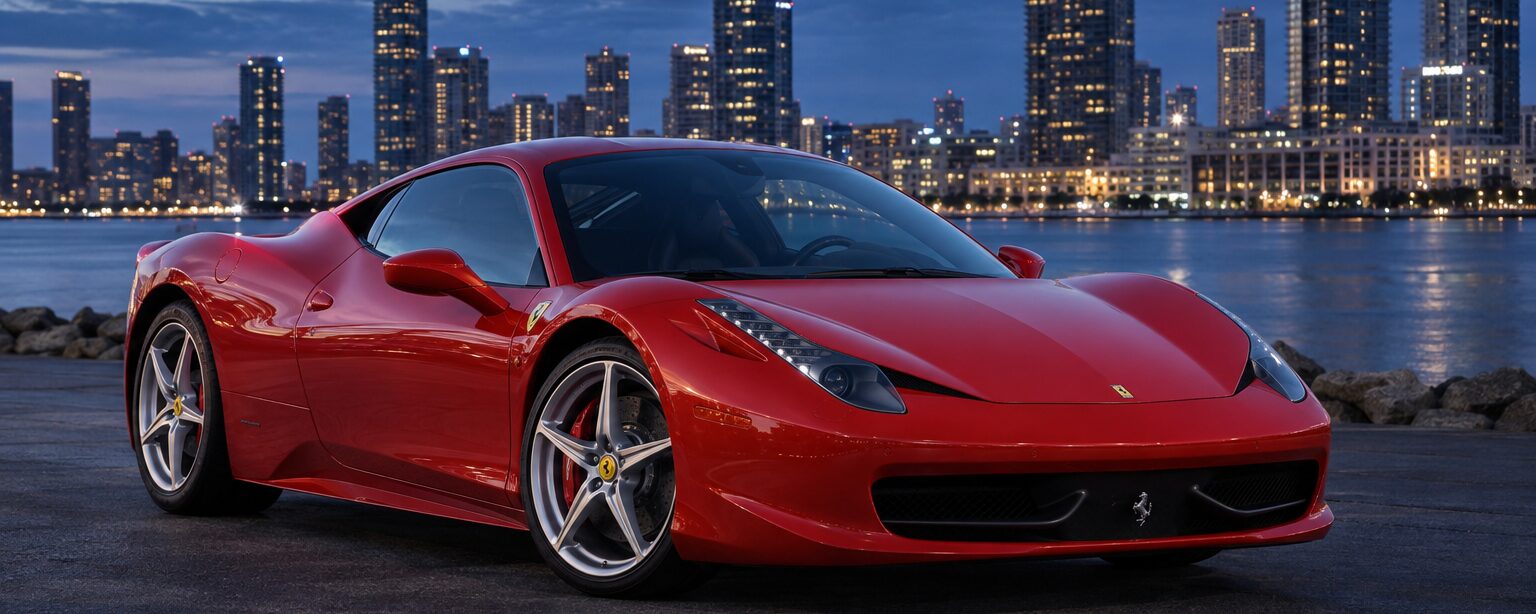

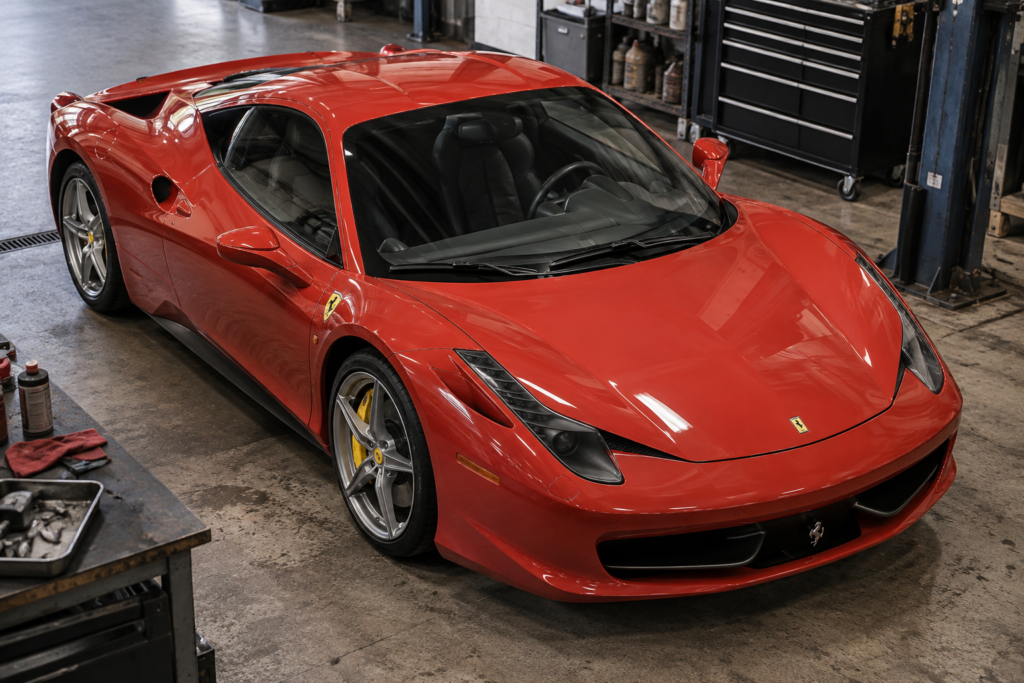
Ferrari 458 Italia in an editorial automotive setting.

Perspectives

Dan Sallis

Dan Sallis

The engine was built around escalation, not just output

The 458’s V8 deserves attention as a piece of mechanical planning, not merely as the source of the noise everyone remembers. Ferrari gave it 4,499 cc, a 90-degree layout, direct injection, dry-sump lubrication, and a 12.5:1 compression ratio. Those choices were not independent decorations on a specification sheet. They supported an engine that could keep working as the revs climbed instead of relying on a large, early torque hit to do all the entertaining.

The dimensions tell part of that story. A 94-mm bore and 81-mm stroke make the engine notably oversquare, which suits an engine designed to operate high in its rev range. Its documented 540 Nm arrives at 6,000 rpm, alongside a factory-rated 570 horsepower. That is useful context: the 458 was not pretending to be a low-speed locomotive. It wanted the driver to select the right gear, keep the engine loaded, and let the power build.

That is also why the dry sump matters beyond technical theater. Keeping the oil supply controlled during hard cornering is a practical requirement for a car whose chassis can generate serious lateral load. Ferrari was solving the conditions surrounding the performance, not just chasing a number for the brochure.

Contemporary technical coverage emphasized the engine’s willingness to continue toward its 9,000-rpm redline, while period road testers described the sound and response rather than reducing them to measurements. The important point is the sequence. The 458 gives its performance a beginning, middle, and final act. Turbocharging made later Ferraris faster in different ways, but this engine made waiting for the upper range feel like the reason to drive the car. That is a mechanical strategy, and a much better explanation of its lasting appeal than “570 horsepower” by itself.

Kenji Nakamura

Kenji Nakamura

The 458 turned software into a driving language

The 458’s most important innovation was not that it had more electronic systems. Plenty of cars can win that argument by adding menus until the owner needs a software update to find the windshield wipers. Ferrari’s achievement was making those systems legible.

Think of the manettino as an interface layer. The driver makes a high-level request: more freedom, more restraint, a different balance between stability and pace. Beneath that request, the electronic differential, F1-Trac, ABS, brake pre-fill, and magnetorheological dampers are dealing with the messy implementation details. The driver does not need to issue separate commands to each subsystem. That would be terrible design, in a car or in software.

Ferrari’s factory material presents the 458 as a coordinated aerodynamic and Formula 1-influenced machine. That language should not be stretched into a claim that its road-car hardware was mechanically identical to a racing system. The useful point is simpler: Ferrari treated the relationship between driver, controls, and chassis as a design problem. The steering wheel was not just a place to put buttons. It became the car’s command surface.

That helps explain why contemporary reviewers focused on clarity and confidence rather than merely complaining about electronic intervention. Car and Driver’s European-market test recorded 0.95 g on its skidpad, but the number is not the whole story. The more revealing question is whether the systems made the car’s behavior easier to interpret without making the interpretation feel automated. The period response suggests that, in that tested configuration, they often did.

“Purity” is a bad metric when it only counts how little software a car contains. A better one is translation: how cleanly does the machine turn a driver’s intention into behavior? The 458 made that a technical achievement, not a compromise.

Marcus Reed

Marcus Reed

A Purist Ferrari That Makes You Work Differently

Here is the argument I keep coming back to: the 458 is a purist’s Ferrari precisely because it refuses to define purity the old way. It gives you a naturally aspirated V8 that keeps pulling toward 9,000 rpm, but it asks you to manage that performance through paddles instead of a clutch pedal and an open gate. That is not a small detail. That is the whole family argument in one car.

The seven-speed dual-clutch transmission is faster and smoother than Ferrari’s earlier automated manual, and it lets the driver keep both hands on the wheel while the car attacks the next section of road. Fine. I understand the logic. I even respect it. But there is a difference between being involved in a decision and being involved in a process. A manual makes you perform the interruption: clutch in, choose the gear, release, feel the engine take the load. The 458 gives you the decision and removes much of the ceremony.

Some people call that progress. Others call it the moment Ferrari misplaced a piece of its soul. Both sides are making a reasonable argument, which is inconvenient and therefore interesting.

The mistake is treating the missing pedal as proof that the car cannot be engaging. Its involvement comes from another direction. The engine rewards commitment to the upper rev range, while the chassis and controls make the driver responsible for choosing how much of the envelope to use. The gearbox does not make the decision for you. It simply executes your decision very quickly.

So, yes, I would still defend the manual on emotional grounds. But I would not pretend the 458 is less of a driver’s car because it lacks one. It is a different kind of driver’s car, and that distinction matters. The 458 did not preserve the old Ferrari ritual. It made a persuasive case for replacing ritual with precision, then left enthusiasts arguing about whether that was a fair trade.

At a glance

Ferrari 458 Italia Key Specs

Specs shown for 2010 European-market Ferrari 458 Italia coupe, 4.5-liter naturally aspirated V8, seven-speed dual-clutch, rear-wheel drive, unless noted.

Engine
4.5L 90-degree V8, dry-sump, direct-injected
Induction
Naturally aspirated
Horsepower
570 hp
Torque
540 Nm
Transmission
Seven-speed dual-clutch automated transmission
Drivetrain
Mid-rear engine, rear-wheel drive
Curb Weight
1485 kg
0–60 mph
Published figures vary

Period test results

Published figures disagree materially.

  • 2010 European-market Ferrari 458 Italia coupe, 4.5-liter naturally aspirated V8, seven-speed dual-clutch, rear-wheel drive3 seconds
  • 2010 European-market Ferrari 458 Italia coupe, 4.5-liter naturally aspirated V8, seven-speed dual-clutch, rear-wheel drive3.3 seconds
  • MotorTrend tested configuration3 seconds
Original MSRP
Not documented
Production
Not documented

Common questions

Ferrari 458 Italia FAQ

What is the Ferrari 458 Italia, and which model years does it cover?

The Ferrari 458 Italia is a two-seat, mid-rear-engine berlinetta produced for the 2009–2015 model-year range. It uses a naturally aspirated V8, rear-wheel drive, and a seven-speed dual-clutch automated transmission. These details describe the Italia model family and should not be applied automatically to the 458 Spider, Speciale, Speciale A, Challenge, GT2/GTE, or GT3 derivatives.

What engine and transmission does the 458 Italia use?

The documented 2010 European-market configuration uses a 4.5-liter, 90-degree, naturally aspirated V8 with dry-sump lubrication and direct gasoline injection. Ferrari rated it at 570 horsepower and 540 Nm of torque, with peak torque at 6,000 rpm. Power is delivered through Ferrari’s seven-speed F1 dual-clutch automated gearbox.

These specifications are configuration-specific; market, model-year, equipment, and derivative differences should be checked before applying them to an individual car.

How quick is the Ferrari 458 Italia?

Period instrumented results vary by publication and test event. Car and Driver recorded 3.3 seconds to 60 mph, an 11.5-second quarter-mile at 125 mph, and 0.95 g on a 300-foot skidpad for a 2010 European-market 458 Italia. MotorTrend recorded 3.0 seconds to 60 mph and an 11.1-second quarter-mile at 125.2 mph for a separate 2010 test.

These are individual publication measurements, not universal results for every 458 Italia. Conditions, vehicle specification, tires, equipment, and test method can affect the outcome.

Which recall issues should a prospective 458 Italia buyer check?

Early-production U.S. cars were associated with a fire-related recall involving the rear-fender heat-shield area. A separate safety campaign concerned potential loss of brake fluid and braking capability involving the Bosch master-cylinder and brake-booster assembly.

Recall completion must be verified by VIN with an authorized Ferrari dealer. If a low-brake-fluid warning, brake warning light, or acoustic buzzer appears, the vehicle should be stopped safely and towed for inspection rather than driven to a repair facility.

Can a general production figure or visible stamped number establish a 458 Italia’s authenticity?

No. A dependable Italia-coupe production count has not been established separately from the wider 458 derivative family, so a neat aggregate scarcity figure should not be treated as settled. Visible assembly stamps or casting and bodywork numbers also do not establish authenticity by themselves, because Ferrari notes that visible stamps can be forged.

For an individual car, authentication requires vehicle-specific VIN and title consistency, factory configuration records, major-assembly and originality checks, physical inspection, and written Ferrari dealer or factory-network verification with a clearly stated scope. Ferrari Classiche’s archive-led comparison and specification-sheet process can support that assessment, but it does not replace individual-car verification.

Ownership guidance

Before You Buy an Ferrari 458 Italia

Start with VIN-verified recall work

Recall status should be the first filter, not an afterthought. Early-production U.S.-market 458 Italias were subject to a fire-related campaign involving the rear-fender heat-shield area. Separately, a later campaign concerned possible loss of brake fluid and braking capability associated with the Bosch master-cylinder/brake-booster assembly. These campaigns have different scopes, so a seller’s statement that “the recall was done” is not enough.

Ask an authorized Ferrari dealer to check the individual VIN and provide campaign status in writing. Look for supporting invoices or dealer records, and inspect the relevant heat-shield area for evidence of completed work. If a low-brake-fluid warning, brake warning light, or acoustic buzzer is present during inspection or a test drive, stop safely and arrange a tow rather than continuing to drive.

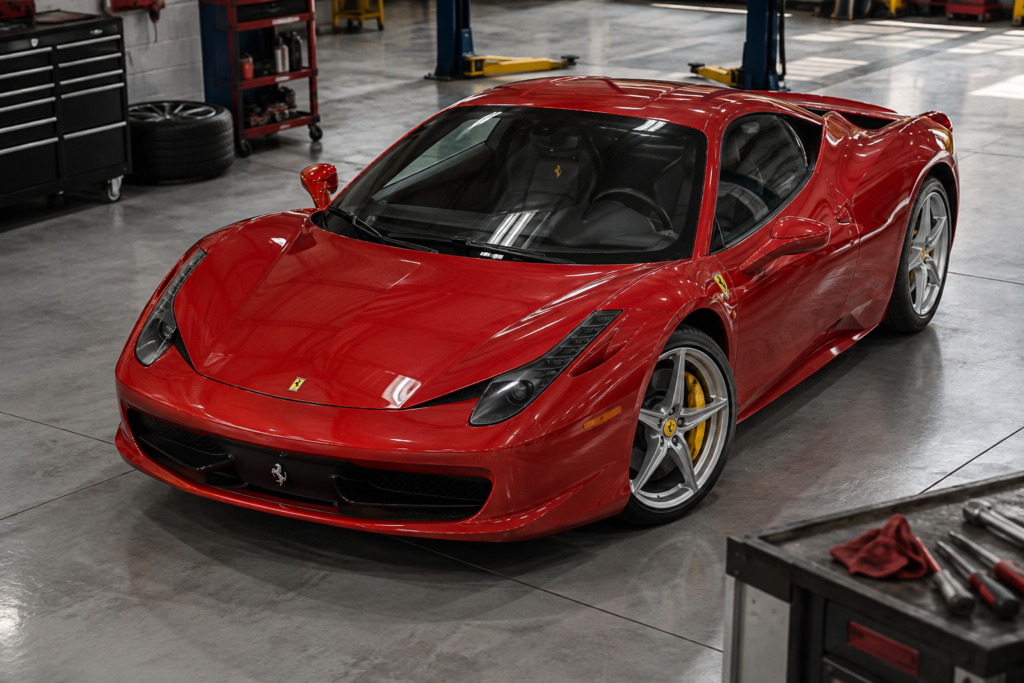
Ferrari 458 Italia in an editorial automotive setting.

Confirm exactly which 458 is being bought

The 458 Italia was sold across the 2009–2015 period, but no defensible mainstream year-by-year change list is established here. Do not assume a later car is automatically better, or pay a premium based only on an advertised model year. Confirm the variant, market, body style, and factory equipment from the VIN, build documentation, window sticker, and Ferrari records. An Italia coupe should not be confused with the Spider, Speciale, Speciale A, or a competition derivative.

Configuration also affects how specifications should be interpreted. The documented European reference car uses a seven-speed dual-clutch transmission, 235/35 ZR20 front tires, and 295/35 ZR20 rear tires. Ferrari’s 1,380-kg dry-weight figure carries option-footnote context, while a publication-tested weight is a separate test event. Use those figures as reference points, not as proof that the individual car has a particular option package or weight.

Require a continuous ownership and maintenance file, including invoices, recall documentation, key records, and evidence of specialist inspections. If records are incomplete, treat that as uncertainty to resolve through inspection and pricing—not as proof of neglect or originality.

Pay for a Ferrari-specific pre-purchase inspection

A general used-car inspection is not sufficient for a car with this level of integrated powertrain and chassis control. Use a Ferrari specialist or authorized dealer able to document diagnostic findings, warning history, fluid leaks, brake condition, suspension operation, tire age and specification, and the condition of the dual-clutch transmission. The factory configuration includes carbon-ceramic brakes, magnetorheological dampers, electronic differential and traction-control systems, so the inspection should identify which components were actually checked rather than simply report that the car drove well.

Have the body and underside inspected for accident damage, poor repairs, structural disturbance, and heat-related evidence. No model-wide corrosion pattern is established by the available record, but the absence of a documented pattern is not a substitute for examining the individual car. Confirm that modifications are disclosed and distinguish factory equipment from aftermarket exhaust, suspension, wheels, software, or cosmetic work.

Do not treat a clean dashboard or attractive detailing as evidence of mechanical condition. A written inspection with photographs, diagnostic results, and a clear list of deferred work gives the buyer a basis for negotiation and a safer ownership decision.

Authentication is evidence, not appearance

For a collector-oriented purchase, originality and identity should be verified at the vehicle level. Ferrari Classiche describes an archive-led comparison with the vehicle specification sheet, together with checks of assembly stamps and confidential casting or bodywork numbers. Ferrari also notes that visible stamps can be forged. Matching-looking numbers, a familiar color combination, or a folder of photographs cannot establish authenticity on their own.

Request the individual VIN, factory specification information, title and registration history, and any Ferrari dealer or factory-network inspection certificate. Make sure the certificate states what it covers: authenticity, conformity to original technical specification, condition, or only a routine inspection. The 458 was presented in 2009, so age-based Classiche eligibility may become relevant for some cars, but eligibility is not the same as certification and should be confirmed directly.

The safest purchase is the car whose configuration, campaign status, history, and present condition are all documented independently. If a seller resists VIN verification or a specialist inspection, walk away from the transaction rather than filling the evidence gap with reputation.