The Buick GNX is easiest to misunderstand when reduced to a horsepower figure, a production count, or a list of cars it embarrassed in a magazine test. Those facts matter, but they do not explain the car. The interesting part is the method.
Buick and ASC/McLaren took a conventional rear-wheel-drive G-body coupe nearing the end of its life and kept finding places to extract more performance. The result was not a clean-sheet sports car with an exotic engine, sophisticated independent suspension, or a prestigious badge. It was a 1987 Buick two-door with a pushrod V6, an automatic transmission, a live rear axle, and black bodywork. The engineering achievement was making those ordinary ingredients behave in an extraordinary way.
That is why the GNX still deserves attention. It was an applied engineering study in extracting speed from constraints. Buick did not solve every problem. In some ways, the car made its compromises more obvious. But the compromises are part of its character, and the way the company worked around them tells us more about late-1980s performance engineering than a smoother, more polished machine might have.
The last escalation of the Grand National
The GNX was the final-year derivative of the Grand National program, offered only for 1987 as Buick's rear-wheel-drive Regal moved toward the end of its production life. Buick sent 547 Grand Nationals to ASC/McLaren for conversion. That arrangement mattered because it allowed the company to apply an unusually concentrated set of revisions without turning ordinary Grand National production into a science project.
The car arrived with the basic architecture of a front-engine, rear-wheel-drive G-body coupe. Its front suspension used control arms, while the rear remained a live axle, revised for the GNX with changes to the torque-arm and Panhard-bar arrangement. That description may sound modest beside the vocabulary of a modern performance car. It was not modest in context. The GNX was taking a platform designed around familiar American coupe priorities and asking it to manage a level of acceleration that forced every supporting system to matter.
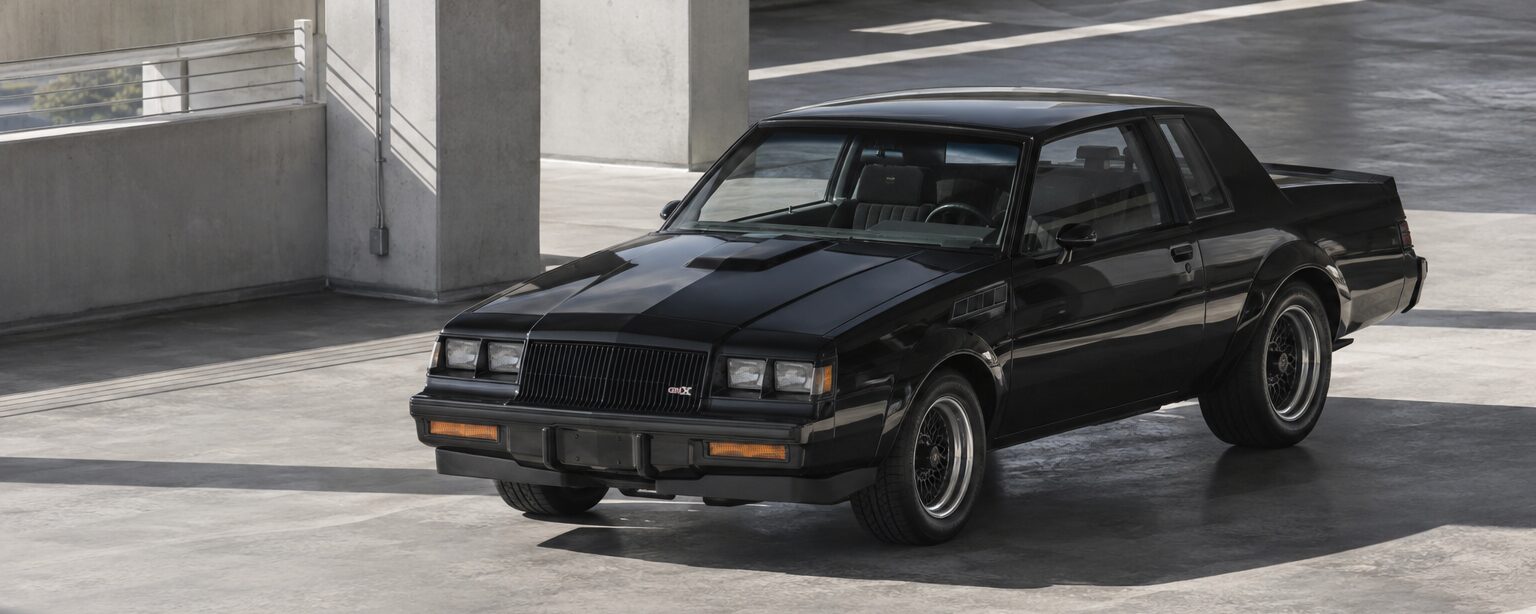
Its external identity made the contradiction visible. The black paint, fender vents, flares, badging, and 16-inch cross-lace cast-alloy wheels gave the GNX a more serious stance than a regular Regal, but the car did not advertise its capability with the visual language of a Ferrari or Porsche. It looked like a Buick that had acquired an unpleasant secret.
That was deliberate engineering theater, whether Buick planned the later mythology or not. The car's performance was more startling because its shape and badge did not prepare people for it.
Why the V6 mattered
The GNX used Buick's 3.8-liter LC2 pushrod 90-degree V6, with an iron block and iron heads, Buick-Bosch sequential fuel injection, and computer-controlled distributorless coil ignition. The engine was not new in the way a clean-sheet racing engine would have been new. Its importance came from how effectively Buick continued developing it.
For the GNX, the turbocharging system used a Garrett T-3 turbocharger and an air-to-air intercooler. The development program also concentrated on airflow, engine control, cooling, and turbocharger response. One of the notable details was the use of a lightweight ceramic turbine wheel. That choice was not decoration. Reducing rotating mass can help a turbocharger respond more quickly, which is exactly the sort of improvement that makes a forced-induction engine feel more immediate without requiring a dramatic increase in displacement.
The factory or advertised figures commonly associated with the GNX were 276 horsepower and 360 pound-feet of torque, with peak torque listed at 3,000 rpm. Those numbers are useful as a description of the program, but they are not the whole story. A turbocharged engine's character depends on how it builds boost, how the controls manage combustion, how the transmission responds, and whether the tires and chassis can use the torque once it arrives.
This is where the GNX becomes more interesting than the familiar “small engine, big power” summary. Buick was not merely adding a turbocharger to a V6 and hoping for a miracle. The package involved the control system, the turbocharger, charge-air cooling, exhaust and airflow work, drivetrain calibration, tires, and chassis revisions. Each change had to cooperate with the others. More torque is not useful if the transmission cannot deliver it, the rear suspension cannot locate the axle, or the tires cannot turn it into forward motion.
That kind of systems thinking is easy to miss because the GNX appears simple. The engine has pushrods. The transmission is an automatic. The rear axle is solid. Yet simplicity in the visible hardware does not mean simplicity in the engineering. Sometimes the difficult task is extracting more from equipment that cannot be replaced with something newer or more elaborate.
The transmission was part of the answer
The four-speed automatic was a General Motors THM-200-4R, reprogrammed specifically for the GNX and paired with a transmission cooler. Its ratios included a 2.74 first gear and a 0.67 fourth gear, with a 3.42 final drive reported for the configuration.
Enthusiasts sometimes treat an automatic transmission as evidence that a performance car is less serious. That argument does not survive contact with the GNX's purpose. The car was built to deploy a large wave of turbocharged torque, and the automatic gave Buick a consistent way to manage that delivery. The transmission was not an apology for the engine. It was part of the mechanism that made the engine's output usable.
This is also why specifications should be read as relationships rather than isolated trophies. The engine's torque, the transmission's first gear, the final-drive ratio, the tire sizes, and the rear-suspension revisions all describe one problem: how to move a relatively large coupe down the road quickly without allowing the powertrain to overwhelm the rest of the car.
The numbers became shocking because the car was not supposed to do that
In a May 1987 instrumented road test, Car and Driver recorded 4.7 seconds from zero to 60 mph and a 13.5-second quarter mile at 102 mph. The same test recorded a 124-mph top speed and 0.80 g on a 300-foot skidpad. The tested car weighed 3,545 pounds at the curb.
Those results belong to that period test configuration, not to every surviving GNX as a universal promise. Even with that necessary qualification, the figures explain the shock. The GNX entered the same acceleration conversation as cars whose public identities were built around speed. A contemporary comparison placed its straight-line performance near the Callaway Twin-Turbo Corvette and not far behind the Porsche 911 Turbo.
The strange part was not simply that Buick made a quick car. Buick had already established the Grand National as a serious performance machine. The strange part was that the GNX challenged the hierarchy of performance. It suggested that a black American coupe with a turbocharged V6 could arrive at the same conversation without borrowing the badge, body shape, or social permission of an exotic car.
That is the original sleeper appeal, before the word became a loose internet category applied to anything with an unexpected engine. The GNX did not need to pretend it was a European sports car. Its force came from refusing the expected script. The badge said Buick. The stopwatch said something else.
A great engine looking for a nicer place to live
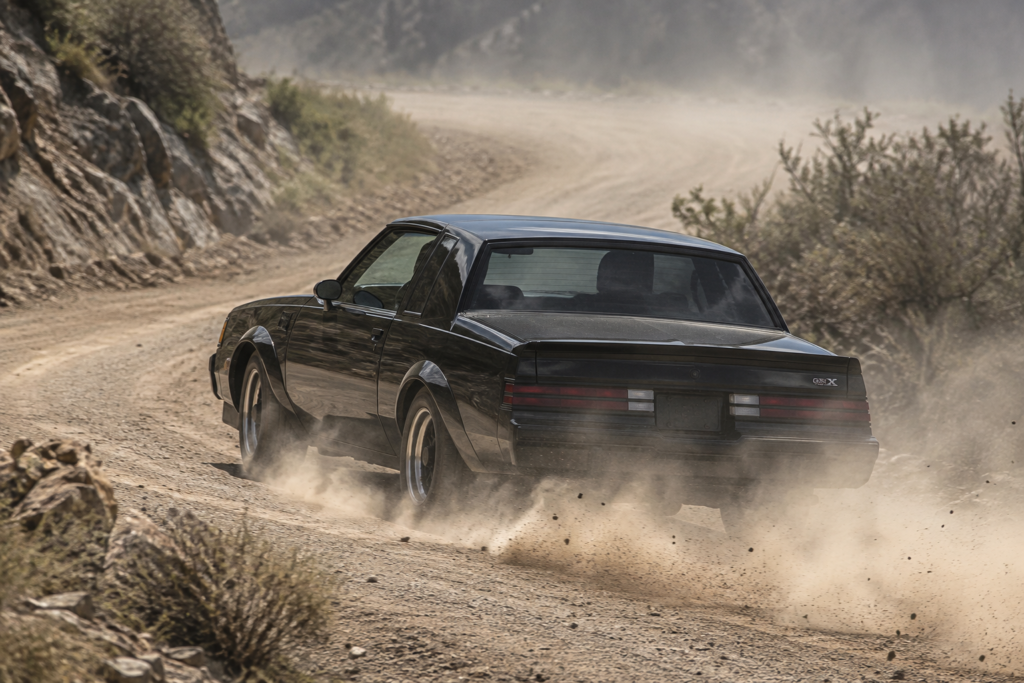
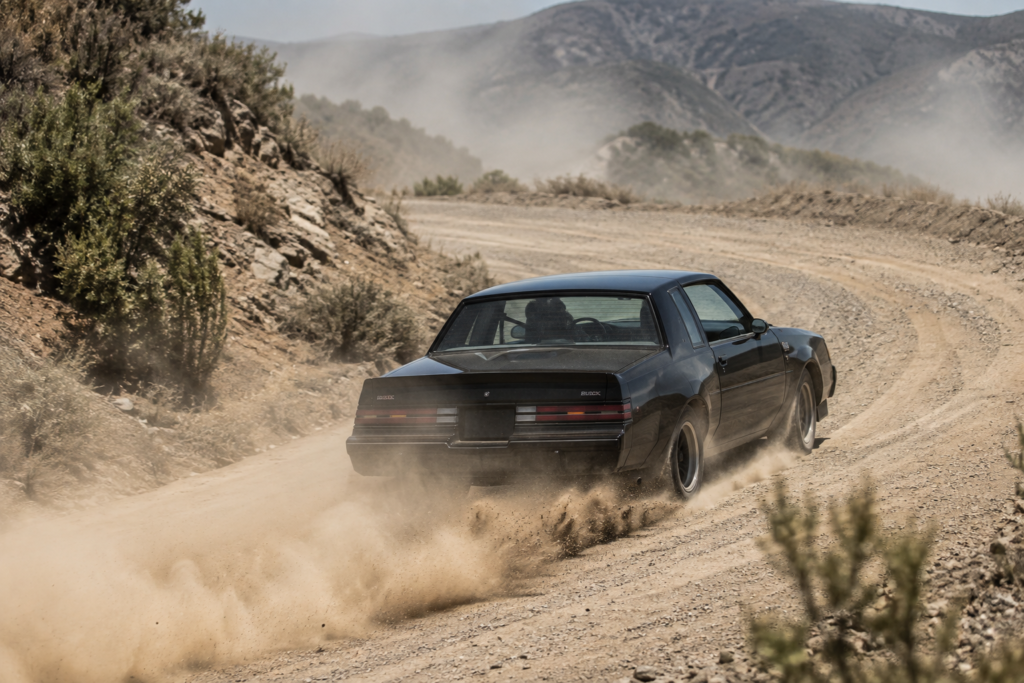
The GNX's period test also delivered the criticism that makes the car historically useful. Car and Driver praised the brutal acceleration but objected to the car's rough-road behavior, rattling, bouncing, and old-fashioned chassis responses. The engine and chassis seemed to belong to different leagues.
That judgment should not be edited out simply because the GNX became collectible. A car can be important without being uniformly polished. In fact, the mismatch helps explain its staying power. The GNX was not a modern performance coupe with every system brought to the same level of refinement. Its turbocharged V6 could produce startling results, while the live-axle G-body beneath it still communicated the limits of its origins.
The documented chassis revisions were meaningful, but they did not erase the platform's basic nature. The rear axle remained a live axle. The front suspension remained control-arm based. The test car used Goodyear Eagle VR50 tires, with P245/50VR-16 front and P255/50VR-16 rear sizes, and the braking hardware included 10.5-inch vented front discs and 9.5-inch rear drums. That combination tells a useful story. Buick improved the car's ability to generate and manage speed, but it did not transform the GNX into an entirely different species of automobile.
There is a temptation to call that a flaw and stop there. I would not. The rough edges are evidence of the engineering problem. The company was extracting speed from an existing architecture, not starting with a blank sheet of paper. The result was dramatic because the powertrain seemed to be pushing beyond the assumptions built into the body around it.
That does not make poor road behavior imaginary or harmless. It means the GNX should be understood as a particular kind of performance car. Its strengths are concentrated. Its straight-line authority is the main event. Its handling and refinement reveal the cost of achieving that authority within the available package.
More than a fast Grand National
A genuine GNX is not simply a highly modified Grand National. The distinction matters mechanically, historically, and financially. The 547-car conversion program created a defined factory-backed package associated with ASC/McLaren, and the GNX received specific exterior, wheel, tire, powertrain, cooling, and chassis work.
That limited production also changed the car's later life. The GNX was scarce from the beginning, but scarcity alone does not explain its status. The car had a clear story: a final-year escalation, a concentrated engineering effort, and performance that violated expectations. Buick reportedly wanted the Grand National program to end with a car writers would remember and collectors would want. That does not prove the company predicted the entire collector market, but it does give the GNX's later importance a stronger foundation than simple rarity.
Over time, the enthusiast conversation shifted. The GNX remained a machine to tune, race, and improve, but it also became an artifact to document and preserve. Serial numbers, build records, the numbered dash plaque, provenance, and original components became part of the car's identity. A matching GNX number can support identity within the documented production run, but it is not a substitute for the VIN, body and build records, conversion documentation, component inspection, or ownership history.
That concern is not separate from the engineering story. It is the next consequence of it. When a manufacturer applies an extraordinary package to an ordinary-looking foundation, the foundation becomes valuable. The question eventually changes from “What can this car do?” to “What exactly is this car?”
The machine and the misdirection
The GNX has survived because its contradictions remain legible. It was a Buick, but it challenged the performance assumptions attached to Buick. It used a V6, but it delivered the sort of acceleration many people expected from a larger engine or a more prestigious badge. It was built from aging architecture, but its turbocharging and electronic control strategy pointed toward a future in which forced induction and software-managed power would become normal performance tools.
Its racing associations also need to be handled honestly. The Grand National name carried Buick's NASCAR credibility, and the company's turbocharged V6 development had links to broader pace-car and Indy-era work. But the GNX was not a literal homologation race car. Its competition lineage was real, while its relationship to racing was largely technological and symbolic rather than a direct race-car-to-road-car derivation.
That distinction makes the car more interesting, not less. Buick did not need to sell a road-going NASCAR special to borrow some of racing's authority. It needed a convincing street machine. The GNX supplied one, using a dealer-sold American coupe as the delivery system for an unusually focused performance experiment.
Decades later, the same logic helped the GNX move into popular culture. Kendrick Lamar's use of the name for his 2024 album and the car's presence in the surrounding Super Bowl moment worked because the GNX already represented underestimated power. It was never only about speed. It was about the surprise of finding force where status signals said there should be none. The disputed identity of the car used in the halftime production only sharpened the distinction between a genuine artifact and a convincing image of one.
The GNX matters, then, because it made constraint visible. Buick did not have the architecture of an exotic supercar, and it did not need it. By combining forced induction, electronic control, cooling, transmission calibration, tires, and chassis revisions, the company extracted extraordinary performance from a platform that was already approaching the end of its life.
The machine eventually tells you whether the theory was right. In the GNX, the theory was right often enough to make history, and imperfectly enough to remain memorable.