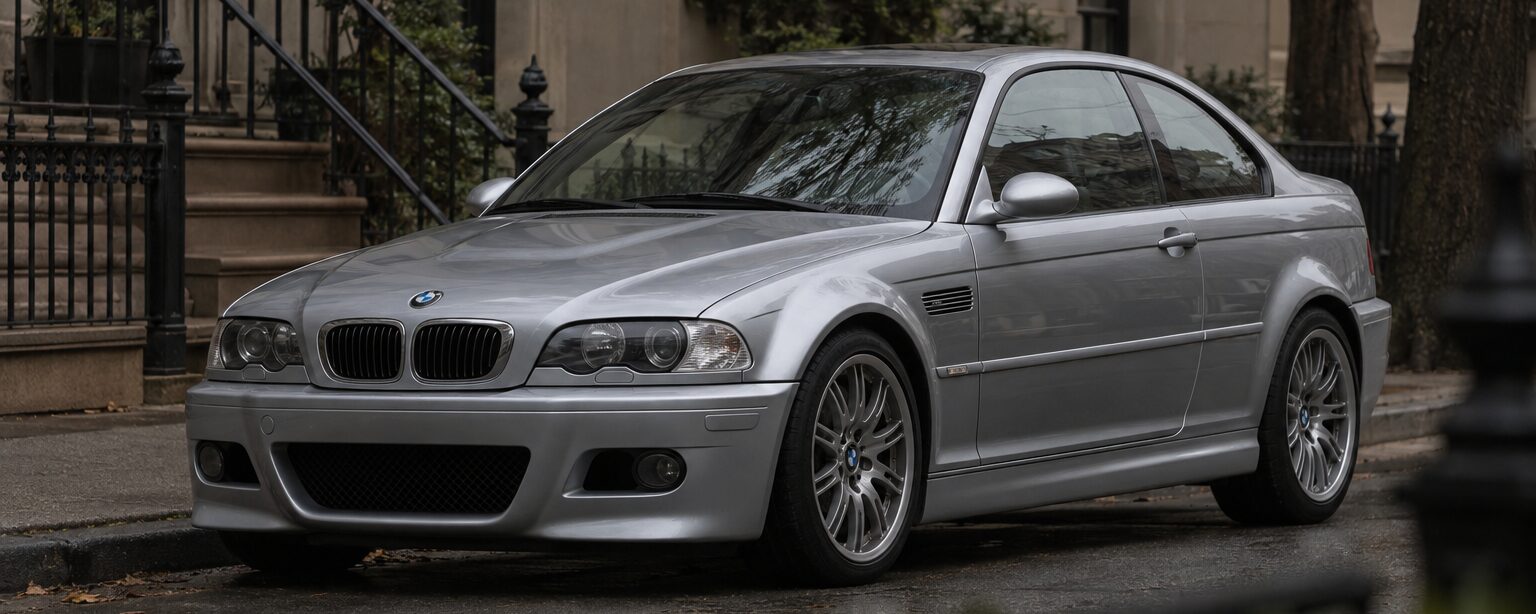
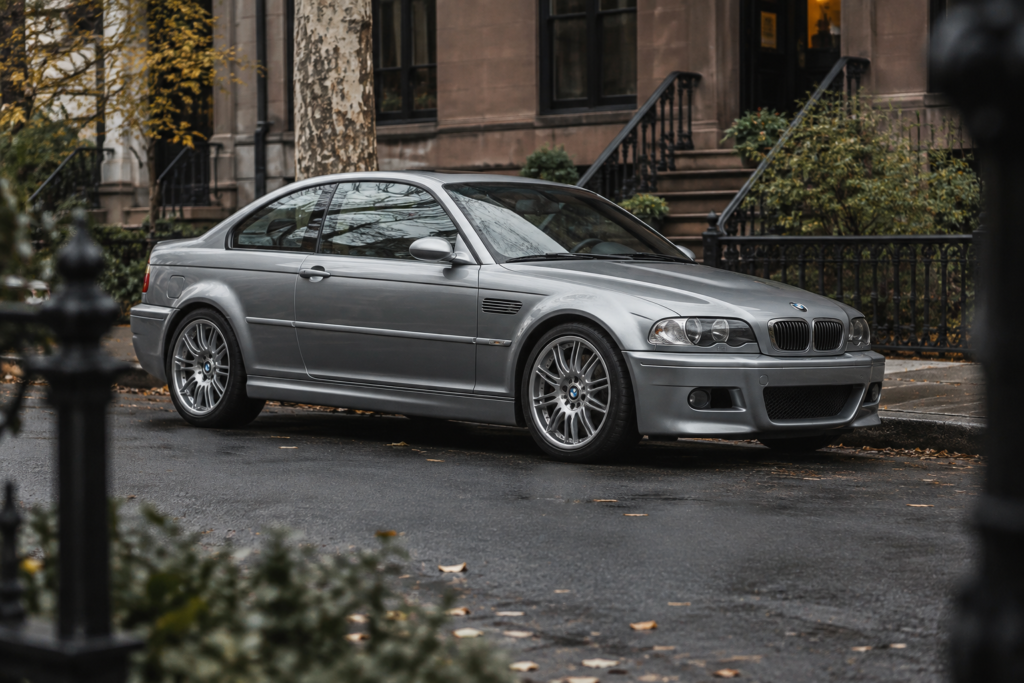
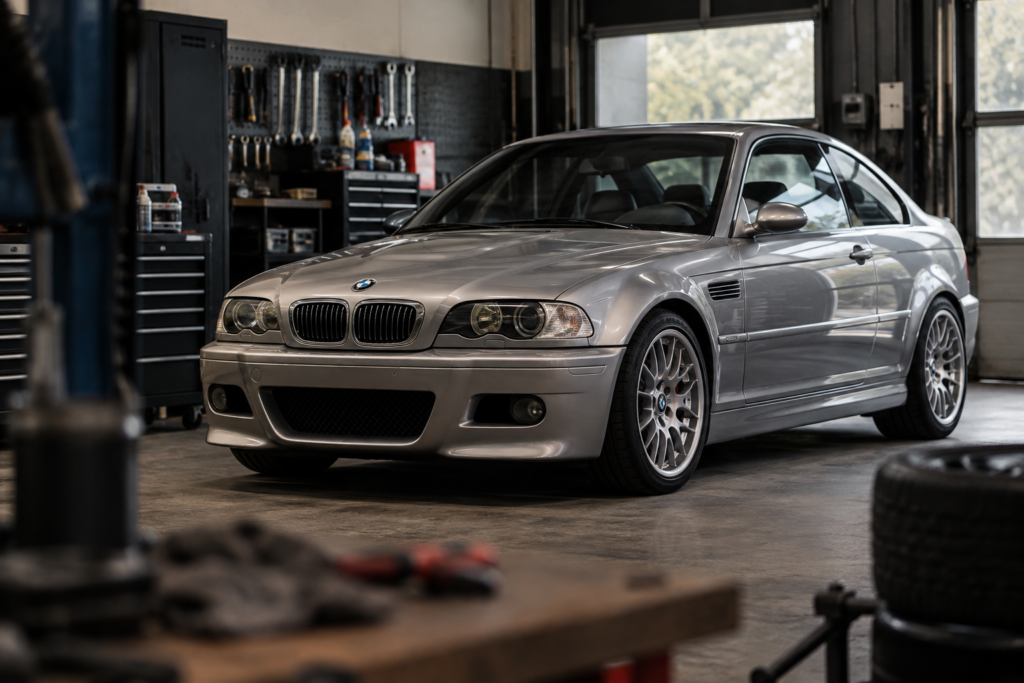
Imagine the same E46 BMW M3 at three different points in its life.
First, it is the complete road car BMW intended: a four-seat coupe with a naturally aspirated straight-six, a manual gearbox, enough comfort for ordinary use, and enough performance to make ordinary use feel like a temporary interruption. Later, the same basic machine becomes a track tool. The priorities change. Brakes matter more than trim. Tires matter more than horsepower. Cooling, alignment, suspension control, and structural condition become the difference between a fast car and an expensive mistake.
Eventually, perhaps, the car becomes a showpiece. Not necessarily untouched, and not necessarily returned to some imaginary factory state. It may be preserved because its owner now values completeness, restraint, and the visible record of what the car was.
That progression is the E46 M3's real story. It was not merely a fast BMW that happened to become collectible. It was a platform that could support changing ideas about what a performance car should be. The road car, the track car, and the showpiece are not three unrelated identities. They are three answers to the same question: what is this machine for?
The complete car came first
The E46 M3 arrived during BMW's 2000–2006 production period as the mature form of the M3 idea. Earlier M3s carried stronger homologation and motorsport associations, but the E46 made the formula broadly usable without making it feel diluted. BMW offered a recognizable 3 Series shape, rear-wheel drive, real rear seats, a naturally aspirated six-cylinder engine, and a chassis that was engineered as a performance system rather than decorated with a badge.
That combination mattered more than any individual specification. The E46 did not ask its owner to choose between a sports car and a useful car. It tried to make the argument that one car could occupy both categories without apologizing for either.
Contemporary reviewers understood this immediately. Car and Driver's period testing described the car as practical enough to function as a passenger car while delivering acceleration that challenged sports cars such as the Porsche 911 Carrera and Chevrolet Corvette. In a 2003 comparison test of a U.S.-market manual coupe, the M3 reached 60 mph in 4.8 seconds, covered the quarter-mile in 13.6 seconds at 105 mph, and recorded 0.87 g on a 300-foot skidpad. Those numbers belong to that specific test car, not every E46 M3 ever built, but they explain why the car's original reputation was not created by collectors looking backward.
The convertible was slower and heavier in its own documented test, reaching 60 mph in 5.1 seconds and carrying a 3,838-pound test weight. That distinction is useful because it reveals what the E46 M3 was not. It was not one universal scalar called “the M3.” Body style, transmission, model year, and equipment changed the experience. The coupe and convertible shared the same broad idea, but they did not express it identically.
That makes the car's completeness more impressive, not less. BMW created a performance machine with enough breadth to exist in more than one form while retaining a clear identity.
The S54 made using the car part of the reward
The heart of that identity was the S54, a 3.2-liter naturally aspirated inline-six. In the documented 2002 U.S.-market manual coupe configuration, BMW rated it at 333 horsepower and 262 lb-ft of torque, with peak torque arriving at 4,900 rpm. The engine used six individual electronically controlled throttles, a high 11.5:1 compression ratio, and BMW's MSS54/S54 engine management with adaptive knock control.
Those details explain why the engine feels conceptually different from a modern turbocharged powertrain, even before anyone starts arguing about nostalgia. The S54 does not reduce performance to one dramatic shove. Its appeal is progression: throttle response, induction noise, rising revs, and the driver's decision to continue asking for more.
BMW did not simply install a larger straight-six and call the problem solved. The engine architecture made the process of using it meaningful. You do not merely receive its performance. You work through it. The reward arrives in the escalation.
That is why the E46 M3's engine remains central to its identity even though the car's appeal cannot be reduced to an engine. Six individual throttles are interesting. They are not magic. The important result is how the engine, transmission, differential, chassis, tires, and brakes cooperate to turn that response into a usable experience.
The factory manual gearbox in the documented coupe used six ratios, from a short 4.23 first gear to a 0.83 sixth, with a 3.62:1 final drive. The numbers matter because they support the engine's character rather than merely decorate a specification sheet. The gearbox keeps the driver involved in the engine's operating range. It turns the powertrain into an interface.
That interface is part of why the E46 became such a durable enthusiast reference point. A high-output engine is easy to praise in isolation. A powertrain that rewards timing, gear selection, and commitment has a longer shelf life.
Then the road car becomes a track car
The next stage in the E46's imagined life is not a dramatic transformation. It begins with recognizing that BMW had already done much of the difficult work.
In the documented 2002 U.S.-market manual coupe, the chassis used BMW M Sport suspension with forged-aluminum lower arms, coil springs, twin-tube gas-pressure dampers, and anti-roll bars. The rear employed a multi-link arrangement with a special subframe and V-brace. Braking hardware consisted of ventilated discs measuring 325 millimeters at the front and 328 millimeters at the rear. Factory tires were 225/45ZR-18 at the front and 255/40ZR-18 at the rear.
This is where the E46 makes a strong argument against horsepower-first tuning. A track car is a system. More engine output is only useful if the tires can transmit it, the brakes can repeatedly convert speed into heat, the cooling system can manage the load, and the drivetrain and structure can tolerate the abuse. Otherwise, the modification is less an improvement than a software update that adds features while breaking the core application.
The E46's factory balance gives an owner something valuable: a known starting point. The right modification addresses a specific limitation. Better tires may improve braking, cornering, and throttle application at the same time. Brake fluid, pads, and cooling may make the car faster over a session without changing its personality. Suspension changes can sharpen response, but only if they preserve the tire contact and geometry that make the car predictable.
That last word matters. Contemporary reporting described the manual M3 as muscular and deliberate, with a raw, loud character and no soft spots in its output curve. The observation applies to a documented 2003 U.S.-market manual coupe, not automatically to every body style or transmission. Still, it captures the car's operating logic. The E46 does not need to be theatrical at every moment. It needs to remain legible when the driver starts asking harder questions.
This is why the platform attracted such different forms of enthusiast attention. Specialist build histories show E46 M3s moving from daily use into track development and, in some cases, toward serious race-car preparation. Other cars received restrained cosmetic changes, CSL-inspired details, or carefully chosen suspension and brake upgrades. The range is broad because the underlying car gives people something to work with.
But “tunable” does not mean “improve everything.” An intake, exhaust, software calibration, coilover kit, larger wheel, and forced-induction system do not become a coherent build merely because they are all expensive. Each change moves a variable. Each variable affects another system. A heavier wheel alters the work the suspension must do. More power increases demands on tires, cooling, and drivetrain components. More grip can expose structural weaknesses that a road car never made obvious.
The E46 rewards owners who understand consequences. It is unusually tolerant of ambition, but it is not immune to bad engineering.
The car's mechanical obligations are part of the story
This is also where the romantic version of the E46 M3 encounters the actual machine.
Owner communities commonly use the phrase “Big Three” to group rod-bearing service, VANOS inspection or rebuilding, and rear axle-carrier-panel or subframe reinforcement. That language is community vocabulary, not proof that every car has suffered the same failure or that every repair has identical urgency. The documented buying concerns are more specific: rear-subframe mounting points can crack or tear; early E46 M3 engines can experience connecting-rod-bearing failure; and SMG hydraulic pumps can fail on applicable cars.
Those are not reasons to dismiss the E46. They are reasons to understand it accurately.
A car with a naturally aspirated engine, a sophisticated management system, a performance chassis, and decades of use is not a museum object simply because its body lines remain clean. The owner has to know what has been maintained, what has been repaired, and what the car is being asked to do now. A road car that becomes a track car changes the workload imposed on every major system. A track car that becomes a showpiece changes the priority from lap-time improvement to documentation and preservation.
This is the mechanical obligation inside the E46's supposedly simple appeal. The car feels direct, but owning one well is not casual. It asks for technical literacy. That demand helped create a specialist culture around the car, with owners discussing preventive work, preferred procedures, inspection findings, and the difference between a documented repair and a seller's confident sentence.
The contradiction is productive. The E46 M3 is celebrated for its analog character, yet its continued enjoyment depends on making informed decisions about mechanical systems. The purity is in the interaction, not in pretending maintenance does not exist.
When a track tool becomes a showpiece
Preservation is often treated as the opposite of modification. The E46 makes that division less convincing.
A nearly original car has obvious historical value as a surviving example of BMW's factory idea. A period-modified car may preserve a different history: the way enthusiasts actually used the platform, the parts they trusted, and the limitations they tried to solve. Neither identity automatically wins.
The strongest showpiece is not necessarily the least touched car. It is the car whose condition and history make sense together. A sympathetic upgrade can tell an honest story about use. A restoration can preserve an important configuration. A cosmetic build can express a period of enthusiasm. What matters is whether the changes serve a coherent purpose or merely accumulate because the parts catalog was available.
The E46 CSL provides the factory's clearest answer to this question. BMW did not create it by chasing excess in every direction. The 2003 CSL reduced weight by 110 kilograms, introduced a carbon-fiber roof, revised the S54 to 360 horsepower, added a distinctive carbon airbox, and used chassis and aerodynamic changes to sharpen the car's purpose. BMW recorded an official 7:50 Nürburgring Nordschleife time.
The CSL demonstrated that the standard E46 M3 had more to give through disciplined reduction. It was not just a louder or more powerful version. It was an argument about focus. Remove mass. Improve airflow. Refine the chassis. Make the driver feel the consequences.
Its SMG-only configuration also exposed a disagreement that still matters. The most concentrated factory expression of the E46 formula used a transmission many enthusiasts consider less satisfying than the manual. That is not a trivial footnote. It shows that engineering ambition and enthusiast definitions of purity do not always point in the same direction.
The same tension surrounds the M3 GTR. The 2001 ALMS racer used a purpose-built 4.0-liter V8 rather than the road car's straight-six, and BMW won the drivers', manufacturers', and team championships. The program also produced a rules controversy over the relationship between the competition car and the road-going homologation response, followed by BMW's withdrawal from ALMS for 2002 after the rules were tightened.
The GTR belongs to the E46 story, but it should not be mistaken for standard road-car equipment. Its importance is partly that it shows how far the platform could be pushed and partly that it escaped the normal boundaries of automotive culture. Through Need for Speed: Most Wanted, the blue-and-silver GTR became a digital object of desire for an audience that may have encountered it first as a game car rather than a race car.
That cultural afterlife helped turn the E46 into more than a BMW enthusiast favorite. It became a shared image, a tuning reference, a racing story, and a childhood aspiration. The road car supplied the recognizable foundation. The GTR supplied the mythology. The CSL supplied the factory's disciplined answer to the question of what the E46 could become when focus mattered more than breadth.
What the three lives reveal
The E46 BMW M3 deserves attention because its identities do not cancel one another out.
As a road car, it made serious performance compatible with daily life. As a track car, it rewarded owners who understood that speed comes from connected systems rather than an isolated horsepower figure. As a showpiece, it raised difficult questions about originality, sympathetic maintenance, and whether a car's enthusiast history should be preserved alongside its factory specification.
That is also why production volume matters. BMW's later heritage summary gives a total of 85,139 E46 M3s across the generation's markets and coupe, convertible, and CSL variants. That is an all-E46 total, not a count for one body style or transmission. The number means the E46 was not an inaccessible racing special. Its ideas reached a broad audience. It became important by spreading an experience, not only by becoming scarce.
Collector interest later gathered around the combination of period acclaim, design, engine character, usability, BMW M history, and the sense that this particular blend would not be repeated in quite the same way. Price is not the proof. Wealthy collectors can make a car expensive; they cannot make an incoherent car satisfying. The E46 earned its reputation before the market began treating it as a modern classic.
The best way to understand one, then, is not to ask whether it should be stock, modified, tracked, or displayed. Ask what each version is trying to preserve.
The road car preserves completeness. The track car preserves involvement through improvement. The showpiece preserves memory, whether that memory belongs to BMW's original engineering or to the enthusiast culture that grew around it.
The E46 M3 survives because it can carry all three meanings without becoming dishonest. It is a finished car, but not a closed argument. BMW built a remarkably integrated solution for a wide range of drivers. Enthusiasts then spent years testing the limits of that solution, repairing its weaknesses, debating its transmissions, changing its priorities, and deciding which parts of the original idea were worth protecting.
That is the human story inside the machine. The car changes because its owner changes. The priorities move from practicality to lap time to preservation, while the underlying E46 remains recognizable beneath the decisions. Few performance cars make that transformation feel so natural.
And that is why the E46 BMW M3 is more than a great engine, more than a successful chassis, and more than a valuable modern classic. It is a performance car that lets people revise their definition of improvement without forcing them to abandon the original idea.