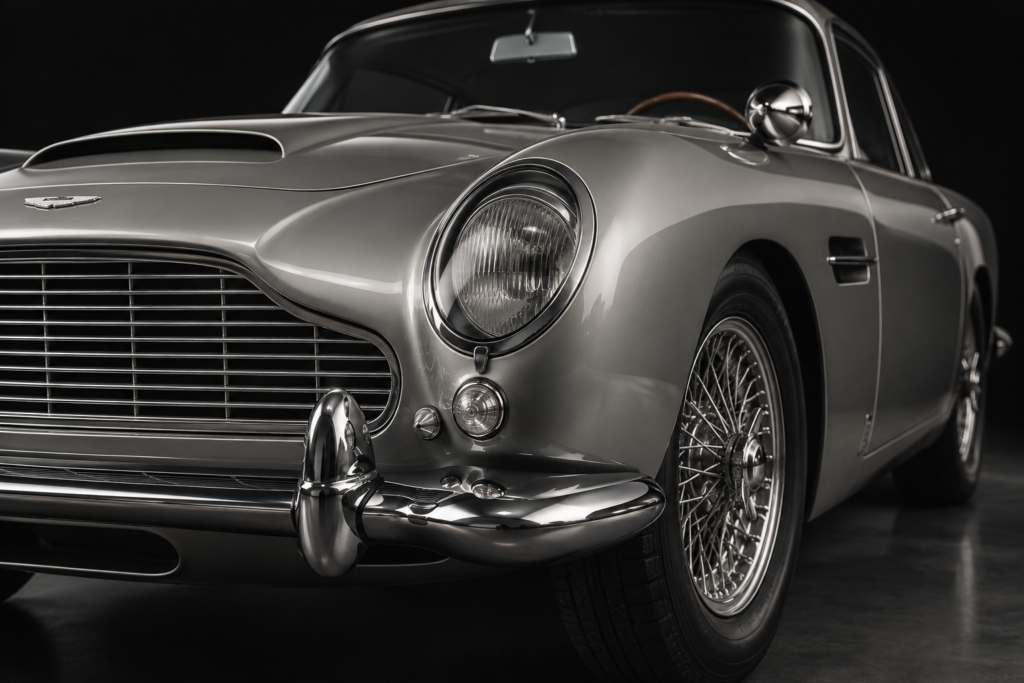
The Aston Martin DB5 is usually introduced with a film scene. A darkened workshop, a revolving number plate, a machine gun hidden behind a lamp, and a man in an immaculate suit asking what the car can do. That image is accurate as far as it goes. It just does not go far enough.
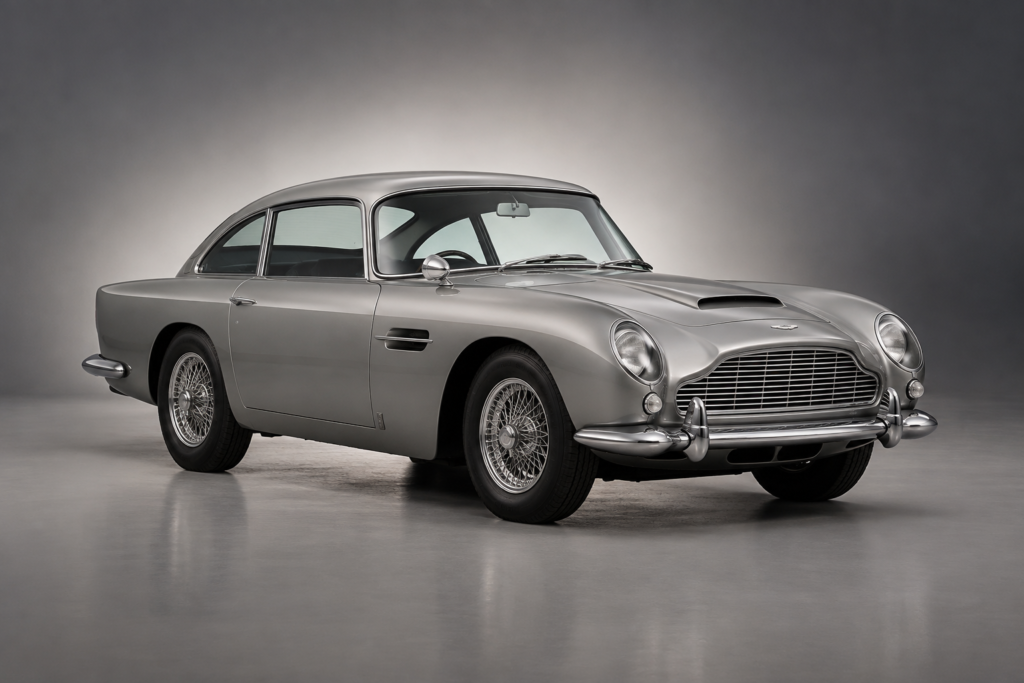
Before Goldfinger turned the DB5 into a recurring cinematic character, Aston Martin had already built the car that mattered. The DB5 was the mature expression of the David Brown-era Aston Martin: a four-seat grand tourer with Italian-shaped aluminium bodywork, a hand-built character and enough mechanical authority to make long-distance speed its natural territory. Its importance is not found in one isolated specification. It is in the way the engine, carburettors, gearbox, chassis and equipment cooperate.
Take the early four-speed car as the reference. The familiar figures are a 4.0-litre twin-overhead-camshaft straight-six, triple SU carburettors and a commonly published 282 bhp. Behind it is a David Brown four-speed manual gearbox. Those details explain more about the DB5 than a list of acceleration times ever could. This was a powerful, serious machine, but its purpose was not to turn every road into a qualifying lap. It was built to make swift travel feel composed.
The final form of an Aston Martin idea
The DB5 did not appear from nowhere, and treating it as an isolated miracle makes the story less interesting. Its lineage ran through the postwar DB series, David Brown's ownership of Aston Martin, Tadek Marek's twin-cam straight-six, Harold Beach's chassis work and Carrozzeria Touring's Superleggera construction. Aston Martin's sporting reputation, including its 1959 Le Mans and World Sports Car Championship success, supplied the authority behind the road cars.
The DB4 had established the basic formula: elegant Italian coachwork wrapped around a British sporting machine. The DB5 brought that formula to a fuller and more confident conclusion. It was not a stripped competition special, nor did it need to pretend to be one. The car carried the memory of racing without demanding that its owner live like a racer.
That distinction matters. A grand tourer is not merely a sports car with extra seats and thicker carpets. Its engineering has to tolerate two apparently opposing demands. It must be capable of serious speed, yet it must also make that speed usable over distance. The DB5's cabin improvements, including carpeting, reclining seats, electric windows and available air-conditioning, were part of the performance story because they changed what sort of journey the car could undertake. Comfort was not an apology for the machinery. It was the reason the machinery existed in this form.
Even the body construction tells the same story. Aluminium panels were formed over a steel supporting structure, producing the lightness and visual delicacy expected of a specialist grand tourer while retaining a substantial underlying chassis. It was an elegant solution, although elegance does not stop dissimilar metals and moisture from having an argument. That combination is one reason surviving cars require careful historical and structural understanding rather than admiration from a safe distance.
What the four-speed tells you
The early four-speed manual DB5 is often treated as a prelude to the later five-speed car. That is a mistake. It is an earlier expression of the same purpose, and the gearbox helps explain the car's character.
For the selected 1964 UK saloon reference configuration, the specification material gives ratios of 2.92 for first, 1.85 for second, 1.25 for third and 1.00 for top, with reverse at 2.52. These numbers are useful because they show how the gearbox organizes the engine's strength. First gear is there to get a substantial car moving. Second and third do the important work once the road begins to open. Top gear is direct, not an overdriven ratio designed to make the engine disappear at a cruise.
That does not make the four-speed crude. It makes it honest. The driver is expected to use the engine and select the appropriate gear rather than rely on a tall transmission to smooth away every mechanical consequence. A four-speed DB5 therefore has a slightly different conversation with the road from a later five-speed example. The later manual arrangement may offer an additional ratio and a different sense of spacing, but it should not be imported into an early car simply because it is more familiar in modern descriptions.
The exact changeover date is not firmly established here, so the useful distinction is early versus later production. Early DB5s used the four-speed manual; a full-synchromesh five-speed manual became available around the middle of 1964 and was associated with later cars. That is a meaningful production change, not trivia for a register book. Gearbox identity affects how the car is driven, how it is documented and how its history should be understood.
The period driving evidence needs the same discipline. MotorTrend reports that 1960s road testers found the ZF shift heavy and the steering effort substantial at low speeds, while the DB5 suited fast, flowing roads and highways. The source does not establish the exact tested transmission, so that observation should not be turned into a universal verdict on every four-speed saloon. Still, it makes mechanical sense as a description of the type of car being discussed. A large, powerful GT with substantial steering effort at parking speeds is not misbehaving merely because it lacks the manners of a modern luxury car.
Triple SU carburettors and the shape of power
The three SU carburettors are more revealing than the usual shorthand suggests. They are not just period decoration under the bonnet. They are part of the DB5's response to the problem of feeding a large straight-six while preserving the character expected of a sporting engine.
The specification material describes a 3995 cc twin-overhead-camshaft straight-six with a 96 mm bore, 92 mm stroke and 8.9:1 compression ratio. It also lists coil ignition and triple SU carburettors. The commonly published power figure is 282 bhp at 5,500 rpm. That figure belongs in the story, but with its proper label: it is a stated period specification figure for the model and reference material, not a dyno result for every surviving car or proof that an individual 1964 saloon still produces it today.
That distinction is not pedantry. Carburettors respond to adjustment, wear, fuel condition and the health of the engine around them. A power figure describes a specification under particular assumptions. It does not tell you whether the throttle shafts are worn, whether the mixture is correct or whether somebody has spent years replacing parts without diagnosing the underlying problem. The machine will eventually settle that argument.
In factory form, the appeal was the combination. The straight-six supplied the scale and refinement; the triple-carburettor arrangement gave the engine its sporting intent; the four-speed gearbox gave the driver a direct way to use it. None of those elements needs to be exaggerated. Calling the engine a race motor would misunderstand the car. Calling the gearbox inadequate because it has only four forward ratios would be equally lazy.
This is also why the DB5 is better understood as a grand tourer than through modern categories that separate comfort and performance too neatly. It had the equipment of an expensive luxury car and the mechanical seriousness of a sporting machine. The two identities were not competing for control. They were the product.
Fast travel, not theatrical aggression
The DB5's chassis supports that reading. The researched reference material describes independent front suspension, a live rear axle located by a Watt linkage and disc brakes at both axles. The arrangement is conventional in its broad logic, but conventional does not mean unsophisticated. A Watt linkage controls the lateral movement of a live axle more carefully than a simple arrangement would, helping the rear suspension do its job without asking the body to tolerate unnecessary sideways movement.
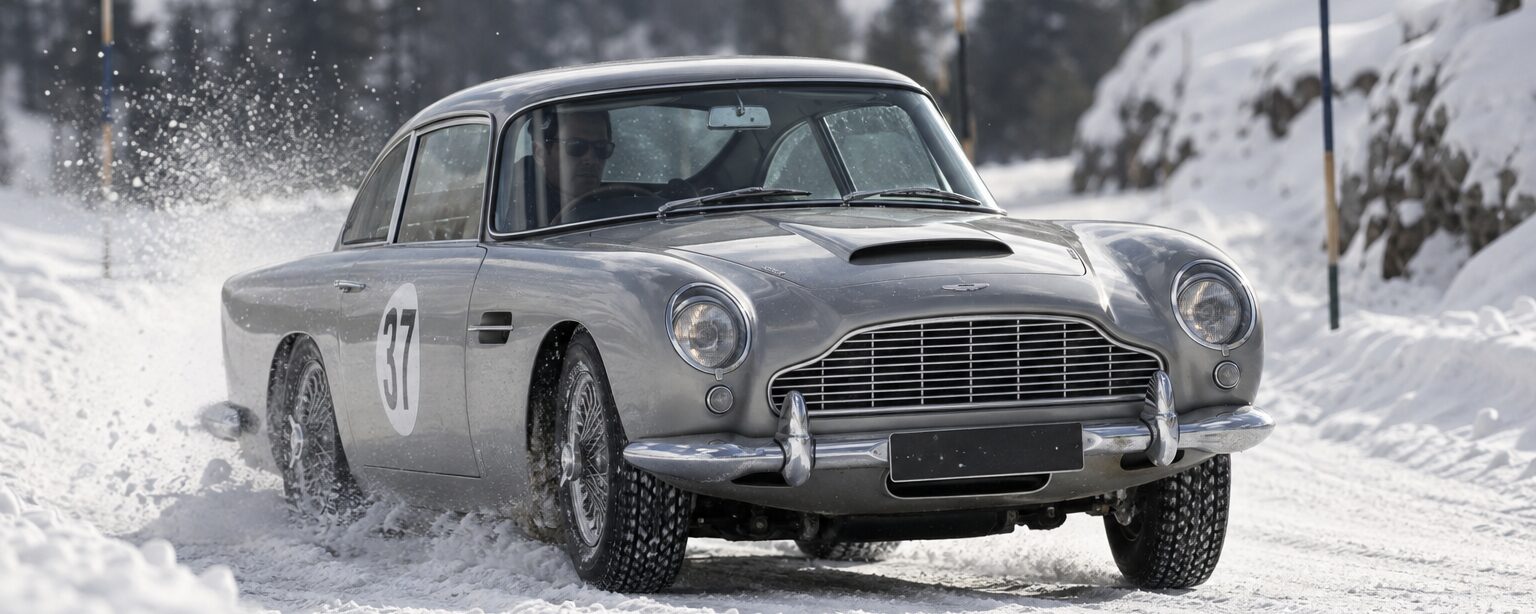
The result is a car whose strengths are likely to emerge as the road opens out. The reported period observations about heavy low-speed steering and a substantial gearshift are not defects to be edited out of the story. They are reminders that the DB5 was built around momentum. At low speed, its mass, steering system and controls are plainly present. At speed on a flowing road, those same physical qualities become part of the sense of occasion.
A second-hand report of one period test gives 0 to 60 mph in 8.1 seconds and a top speed of 142.6 mph, with 0 to 100 mph reported as under 20 seconds. Those figures belong to one instrumented event, secondarily reported by MotorTrend, and the original publication, conditions and exact transmission remain unspecified. They are useful as a glimpse of the car's period performance, not as a promise attached to every DB5. The distinction is especially important with hand-built cars that have lived different lives for more than half a century.
What matters more than the numbers is the kind of performance they represent. The DB5 was not trying to be a small, nervous car that rewarded constant provocation. It was a substantial machine with the ability to cover ground quickly while carrying passengers and luggage in a properly appointed cabin. Its sporting credibility was real, but its ambition was broader than lap time.
The car existed before the myth
Goldfinger released in the United Kingdom on September 17, 1964, and the DB5's association with James Bond became one of the strongest pieces of automotive mythology ever created. The official Bond account describes the DB5's repeated film appearances and the prototype supplied for gadget work. Specialist histories identify DP/216/1 and the registration BMT 216A in that screen story, although the full chronology of the cars and modifications still deserves careful archival treatment.
The important point is that cinema amplified an existing object. It did not take an anonymous car and give it an identity from nothing. The DB5 already combined the things that made the fantasy persuasive: speed, discretion, expensive materials, technical cleverness and the promise of moving through the world with unusual control. The gadgets made that promise visible. They were theatre built on a credible machine.
That is why the standard production car deserves to be separated from the screen car. A film-modified prototype, an original road-going DB5, a later replica and a modern Goldfinger Continuation car may share an outline, but they do not share the same history. Aston Martin's continuation cars are modern reproductions of the screen fantasy, not original 1960s cars. Their existence confirms the strength of the mythology while also making the distinction between artifact and recreation more important.
The Bond image can flatten the model if allowed to do all the talking. It makes the DB5 seem defined by silver paint, concealed weapons and a single registration number. The real car had other colors, other body styles and other uses. The reported shooting-brake story is particularly useful because it restores a human scale to the glamour. David Brown wanted room for polo equipment, hunting gear and dogs, and the standard leather interior was not proving especially cooperative. Harold Radford's conversions created a more useful rear load area while retaining the mechanical and chassis character of the GT, according to specialist accounts.
That is not a Bond story. It is a story about an owner asking an expensive machine to fit an actual life. Coachbuilding solved the problem. The DB5 could carry fantasy, but it could also carry equipment that had no business sharing space with a spy film.
Why provenance became part of the car
Only a short run of original DB5s was built across saloons, convertibles and shooting brakes. The preferred specialist figure is 1,022 cars across all original variants, although another published compilation gives 1,021. Aston Martin separately describes fewer than 900 saloons, which is a different body-style scope. None of those figures supports an exact count of 1964 four-speed saloons, and it would be a mistake to derive one by subtraction.
The short production period and the number of factory and coachbuilt distinctions help explain why provenance has become part of the DB5's identity. The question is not simply whether a car looks like a DB5. It is what car it was, how it was specified, what has happened to it and which parts of that history can be documented.
An Aston Martin Heritage Trust certificate with a build sheet can support recorded information about a vehicle's chassis and engine numbers, gearbox number, colors and optional equipment when those details are present. It can support factory provenance and as-built configuration, but it is not proof of legal title, registration or the originality of every component currently fitted. Those are separate questions.
The body and chassis deserve similar care. Aluminium panels over a steel structure create the possibility of electrolytic corrosion where moisture remains at dissimilar-metal interfaces, while conventional steel corrosion can affect structural members. Sills, wheel arches, door bottoms, bonnet, boot, floors, jacking points and suspension-mount areas all matter. A polished exterior tells you very little if the history of structural repairs is missing. Restoration photographs and invoices are not glamorous, but they are often more informative than a fresh coat of paint.
That does not mean every DB5 should be treated as a catastrophe waiting to happen. It means the car's reputation should be tested against failure mechanisms and documented work. A sympathetic mechanical upgrade may preserve the purpose of a usable grand tourer; an undocumented conversion may create a different historical object. The answer depends on what was changed, why it was changed and whether the change is recorded.
The DB5 that remains
The DB5's later mythology made Aston Martin recognizable far beyond the specialist world, but it also obscured the car that came first. Under the cinematic surface is a coherent piece of engineering: a large straight-six breathing through three SU carburettors, a substantial claimed power output, a direct four-speed manual gearbox and a chassis designed to carry speed with dignity.
That dignity is the key. The DB5 was not a competition car disguised as a luxury car, and it was not a luxury car borrowing a sporting image it could not support. It was Aston Martin's answer to a more demanding question: how do you build a fast car for someone who expects comfort, craftsmanship and presence as part of the performance?
The four-speed saloon answers with a little weight in the controls, a little noise from the machinery and a great deal of mechanical purpose. It asks the driver to understand what the engine and gearbox are doing rather than treating them as invisible appliances. That is precisely why the DB5 remains more interesting than its legend. The gadgets made it famous. The machinery gave the legend something worth remembering.